
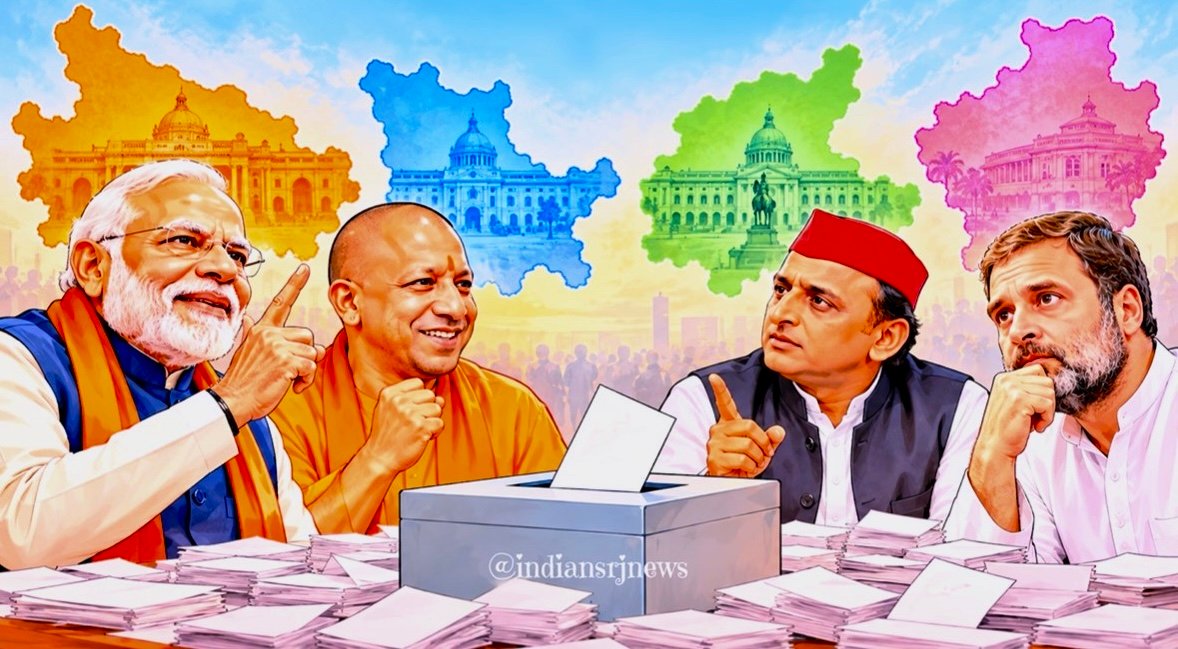
MLC Election Results 2026: BJP Leads Across Four States, SP Wins 5 Seats in UP; Political Battle Heats Up Ahead of 2027
|
Getting your Trinity Audio player ready...
|
New Delhi: The results of the Legislative Council (MLC) elections across Uttar Pradesh, Bihar, Karnataka and Maharashtra have intensified political discussions ahead of the upcoming electoral battles. The BJP and its allies performed strongly in several constituencies, while the Samajwadi Party (SP) registered a notable performance in Uttar Pradesh. Congress also secured an important victory in Maharashtra, while Jan Suraaj made its presence felt in Bihar.
The results are particularly significant for Uttar Pradesh, where Assembly elections are scheduled for 2027. Although MLC elections cannot directly predict Assembly election outcomes, they provide political parties with an opportunity to assess their organisational strength and support among specific voter groups.
BJP and SP Face a Close Contest in Uttar Pradesh
In Uttar Pradesh, the BJP won six of the 11 Legislative Council seats, while the Samajwadi Party secured five seats. Compared with the previous election in 2020, the SP improved its performance, strengthening its position in several constituencies.
The SP’s victories in both Varanasi seats were particularly significant. The party also secured wins in constituencies including Lucknow Graduate and Agra-Aligarh Teacher, while the BJP maintained its presence in several areas, including Meerut.
Varanasi is the parliamentary constituency of Prime Minister Narendra Modi, making the SP’s performance there politically noteworthy. SP chief Akhilesh Yadav highlighted the results as an indication of his party’s growing political strength and criticised the BJP.
The results have renewed discussions about the political competition between the BJP and the SP ahead of the 2027 Uttar Pradesh Assembly elections.
Bihar MLC Elections: BJP Wins Three Seats, Jan Suraaj Opens Its Account
Bihar’s eight Legislative Council seats witnessed a multi-party contest. The BJP won three seats, while the Janata Dal (United), or JD(U), and the Rashtriya Janata Dal (RJD) secured one seat each. Jan Suraaj also won one seat, marking an important development for the party’s political presence in Bihar. Two seats were won by independent candidates.
For Jan Suraaj, the result represents an opportunity to expand its presence in the state’s political landscape. Meanwhile, the RJD’s victory in the Patna Teachers’ constituency added another dimension to the contest.
Karnataka: BJP-JD(S) Alliance Sweeps All Four Seats
In Karnataka, the BJP and its ally, the Janata Dal (Secular), achieved a clean sweep by winning all four Legislative Council seats. The BJP secured three seats, while the JD(S) won one.
The result has attracted attention because Karnataka is governed by the Congress. However, MLC elections involve specific electorates, and their outcomes should not be treated as a direct reflection of statewide public opinion.
Maharashtra: Congress Scores an Important Victory in Nagpur
Maharashtra’s five Legislative Council seats also produced an interesting political contest. In the Nagpur Graduate constituency, Congress candidate Abhijit Vanjari defeated BJP candidate Sudhakar Kohale by 3,271 votes.
Nagpur holds considerable political significance because it is the home region of Maharashtra Chief Minister Devendra Fadnavis and the headquarters of the Rashtriya Swayamsevak Sangh (RSS). Consequently, the Congress victory attracted considerable political attention.
The Maha Vikas Aghadi (MVA) secured three seats, while the ruling Mahayuti alliance’s BJP and Shiv Sena won one seat each.
Four States, 28 Seats: What Do the Results Show?
The elections covered 28 Legislative Council seats across four states. The BJP performed strongly, while its allies also secured victories in several constituencies.
In Uttar Pradesh, the SP’s five victories demonstrated that the opposition remains competitive in several important constituencies. In Bihar, the results were distributed among multiple parties and independent candidates. Karnataka witnessed a complete sweep by the BJP-JD(S) alliance, while Maharashtra saw a significant victory for Congress in Nagpur.
Taken together, the results highlight the continuing competition between the BJP-led alliances and opposition parties across different regions.
Will the MLC Results Influence the 2027 Uttar Pradesh Assembly Elections?
With the Uttar Pradesh Assembly elections expected in 2027, political parties are likely to intensify their organisational preparations and outreach efforts.
The BJP will aim to retain power, while Akhilesh Yadav’s Samajwadi Party will seek to strengthen its position and challenge the ruling party. The latest MLC results provide both parties with political talking points as they prepare for the next major electoral contest.
The SP’s performance in Varanasi and other constituencies may encourage the party, while the BJP’s victories in several seats will offer reassurance to its supporters.
However, it is important to note that MLC elections involve different voter groups, including graduates and teachers in designated constituencies. Assembly elections involve a much broader electorate. Therefore, the results should not be interpreted as a definitive prediction of the 2027 Assembly election outcome.
Conclusion
The 2026 MLC elections across Uttar Pradesh, Bihar, Karnataka and Maharashtra have produced a mixed political picture. The BJP and its allies demonstrated strength in several constituencies, while the SP’s performance in Uttar Pradesh and Congress’s victory in Maharashtra gave the opposition reasons to remain optimistic.
As the 2027 Uttar Pradesh Assembly elections approach, the key question will be whether these results translate into stronger organisational momentum and broader voter support.
For now, the MLC results have added another chapter to the ongoing political contest between the BJP and opposition parties, with Uttar Pradesh remaining one of the most closely watched battlegrounds.


