Two Mega Ganga and Varuna Elevated Corridor Projects Worth ₹25,445 Crore Approved
|
Getting your Trinity Audio player ready...
|
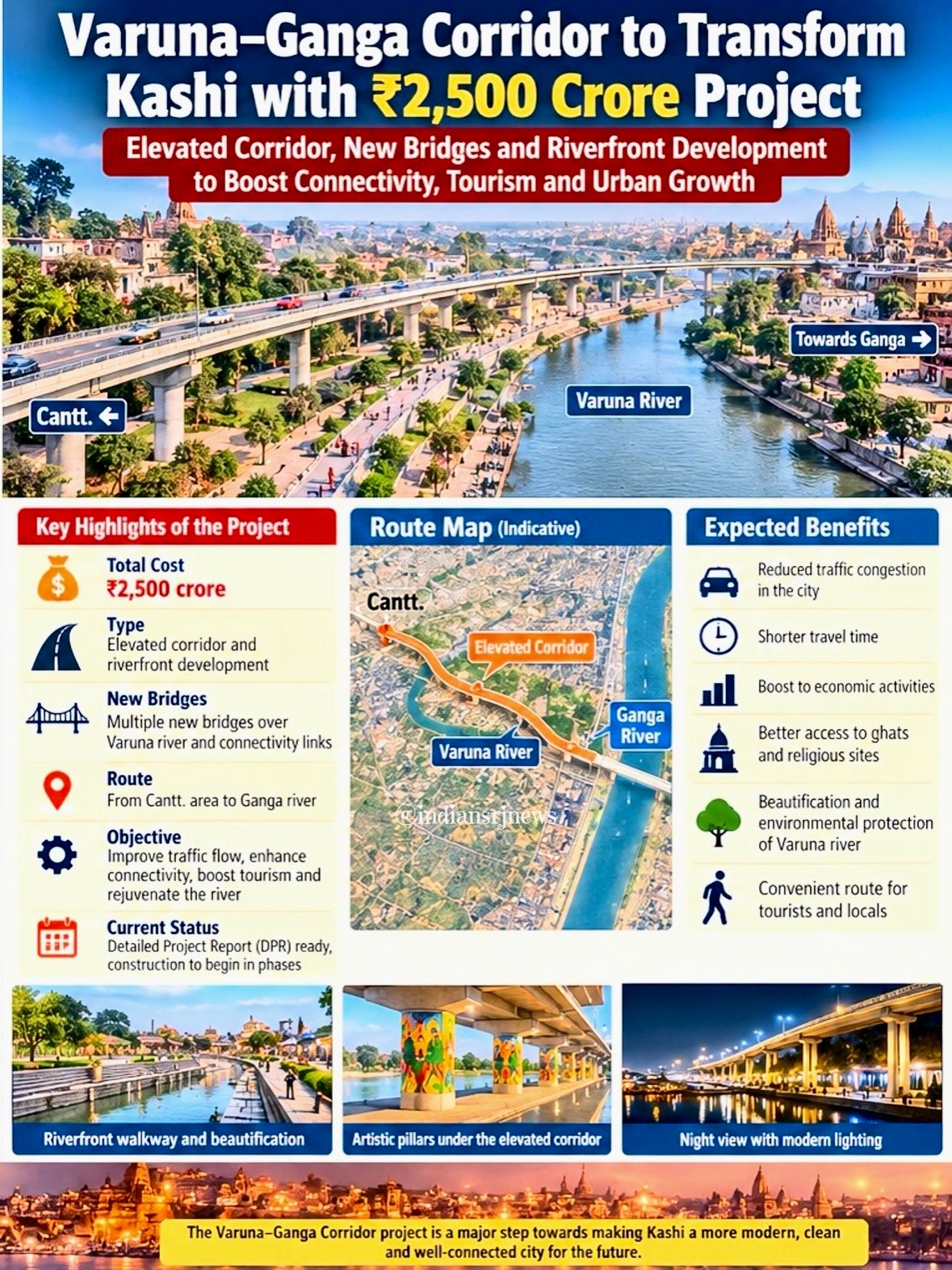
Varanasi, Uttar Pradesh: The holy city of Kashi, globally known for its spiritual heritage, ancient temples and cultural traditions, is moving towards a new era of modern infrastructure and connectivity. With increasing traffic congestion, a growing number of tourists and pilgrims, and rising transportation requirements, two major elevated corridor projects along the Ganga and Varuna river regions have been approved to transform the city’s road infrastructure.
The two projects together have an approved capital cost of approximately ₹25,445.96 crore. The Varuna Elevated Corridor has been approved at a cost of ₹10,998.32 crore, while the Ganga Elevated Corridor has an estimated approved cost of ₹14,447.64 crore.
These ambitious infrastructure projects aim to improve road connectivity, reduce travel time, ease traffic congestion and strengthen transportation links between Varanasi and neighbouring regions of eastern Uttar Pradesh.
The projects are not merely about constructing new roads and bridges. Their broader objective is to reduce traffic pressure on the city’s congested urban roads, improve access to important religious and commercial destinations, and strengthen Varanasi’s position as a major regional transportation and economic hub.
1. Varuna Elevated Corridor: A 43.218-Kilometre Infrastructure Project
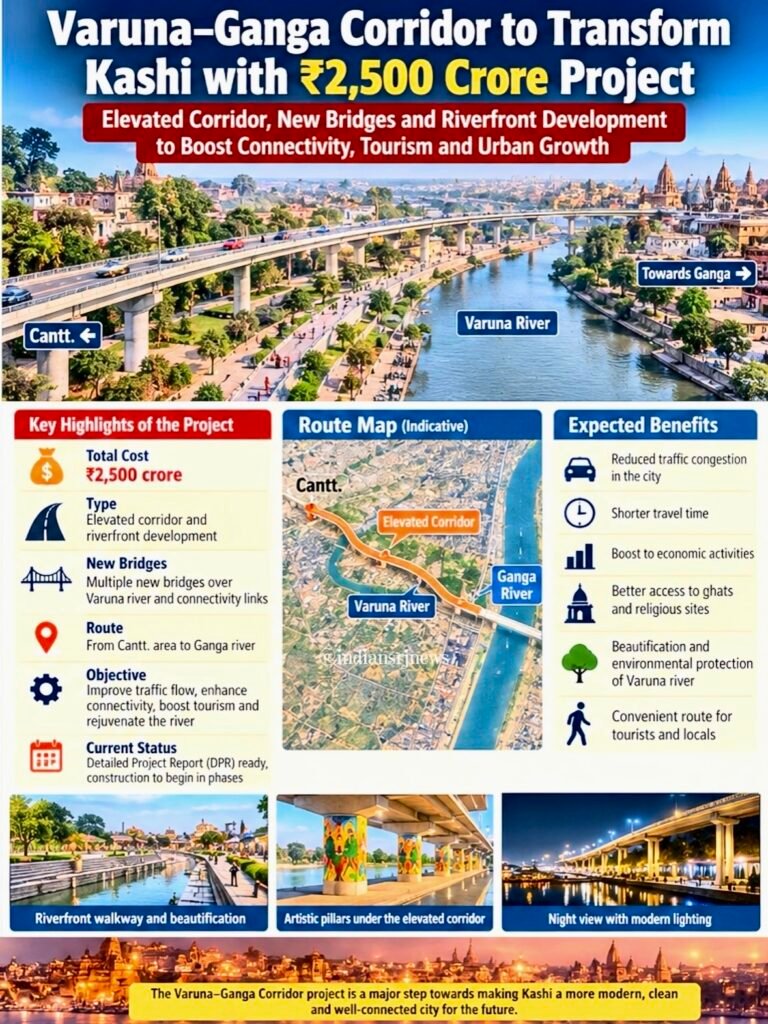
The Varuna Elevated Corridor is one of the major infrastructure projects planned to improve traffic management in Varanasi.
The proposed corridor will have a total length of 43.218 kilometres and will primarily consist of six-lane and four-lane elevated road sections.
It will connect National Highway-31 (NH-31) with the Varanasi Ring Road, providing an alternative transportation route for vehicles travelling through and around the city.
Currently, several important roads in Varanasi experience considerable traffic congestion, particularly during peak hours, religious festivals and major public events. The new corridor is expected to provide additional road capacity and help divert through-traffic away from congested urban stretches.
The project includes elevated carriageways, flyovers, ramps, loops and service roads to facilitate smoother entry and exit for vehicles travelling in different directions.
The Union Cabinet approved the Varuna Elevated Corridor project on July 15, 2026. The National Highways Authority of India (NHAI) will implement the project under the Hybrid Annuity Model (HAM).
The total approved capital cost is ₹10,998.32 crore. This includes approximately ₹4,565.33 crore for civil construction and ₹934.91 crore for land acquisition.
2. How Much Travel Time Could the Varuna Corridor Save?
One of the most significant expected benefits of the Varuna Elevated Corridor is a reduction in travel time.
According to the project details, the corridor has been designed considering an operational speed of approximately 80–100 kilometres per hour.
Once completed, travel time between NH-31 and Kashi Railway Station is expected to decrease from approximately 40 minutes to around 20 minutes.
This could result in nearly 50 per cent time savings on the specified journey.
The improved connectivity is expected to benefit private vehicle owners, commercial transportation, public transport services, logistics operators and people travelling between different parts of Varanasi.
Important areas such as the Cantonment region, Phulwaria and Chowkaghat could also benefit from improved connectivity through the wider road network.
However, the actual travel-time savings will depend on the final road connections, traffic conditions and operational arrangements.
3. Ganga Elevated Corridor: A 46.039-Kilometre Greenfield Project
Alongside the Varuna project, the Ganga Elevated Corridor is another major infrastructure initiative expected to reshape Varanasi’s transportation network.
The project will cover approximately 46.039 kilometres and has been approved as a six-lane greenfield elevated corridor.
It will connect National Highway-19 (NH-19) with the Varanasi Ring Road, improving connectivity towards important areas including Ramnagar and the Banaras Hindu University (BHU) region.
The Union Cabinet approved this project on July 15, 2026, with an approved capital cost of ₹14,447.64 crore.
The proposed infrastructure includes a six-lane elevated road, ramps, loops, link roads, service roads, major bridges and facilities for pedestrian movement.
The corridor is intended to improve connectivity between important transportation routes and major urban and economic centres in the region.
4. A 910-Metre Cable-Stayed Bridge Over the Ganga
One of the most prominent engineering features of the Ganga Elevated Corridor is a proposed 910-metre cable-stayed bridge over the River Ganga.
A cable-stayed bridge is a modern bridge structure in which the bridge deck is supported by strong cables connected to tall towers or pylons.
Such bridges are designed to carry heavy traffic loads while providing an efficient structural solution for crossing large rivers and other obstacles.
The project also includes a proposed elevated pedestrian infrastructure structure of approximately 1.32 kilometres, described as an extradosed foot over bridge-cum-major bridge.
Facilities such as travelators are planned to make pedestrian movement easier.
The aim is to improve access to important religious and urban areas, including the Kashi Vishwanath Temple region.
Other proposed features include a railway overbridge above the existing and proposed Malviya Bridge alignment, emergency parking facilities, noise barriers and architectural lighting.
These engineering components are expected to make the project one of the most significant infrastructure developments in the Varanasi region.
5. Better Connectivity for BHU and Lanka
The Ganga Elevated Corridor is also expected to improve connectivity around the Banaras Hindu University and Lanka areas.
The project includes a proposed elevated spur connecting the BHU/Lanka region towards Samne Ghat.
This connection is particularly important because the Lanka intersection experiences substantial traffic movement involving students, local residents, employees, visitors and commercial vehicles.
BHU is one of the most important educational institutions in northern India and attracts a large number of people every day.
Improved road infrastructure could help separate local traffic from vehicles travelling through the wider corridor network.
The development is also expected to improve connectivity towards Ramnagar and surrounding areas.
6. Easier Access to Kashi Vishwanath Temple and the Ghats
Varanasi is one of India’s most important religious and tourism destinations.
The Kashi Vishwanath Temple, Dashashwamedh Ghat, Assi Ghat, Namo Ghat, Ramnagar Fort and Banaras Hindu University attract millions of visitors throughout the year.
During major religious occasions such as Sawan, Maha Shivratri, Dev Deepawali and other festivals, traffic congestion increases significantly across several parts of the city.
The proposed Ganga and Varuna corridors are expected to provide additional road capacity and alternative routes, helping improve connectivity to important parts of Varanasi.
However, it is important to understand that these elevated corridors will not directly connect every temple or ghat. Access will depend on the approved alignment, ramps and connecting roads.
The projects are primarily designed to improve the city’s overall transportation network.
7. Better Connectivity to the Airport, Railway Stations and Ramnagar Port
Another important objective of the two projects is to strengthen multimodal connectivity in Varanasi.
The Varuna Elevated Corridor is expected to improve connectivity towards important transportation facilities, including Lal Bahadur Shastri International Airport, Kashi Railway Station, Varanasi City Railway Station, Varanasi Junction and Pandit Deen Dayal Upadhyaya Junction.
Similarly, the Ganga Elevated Corridor is planned to strengthen connectivity towards the airport, railway stations, Ramnagar and the Inland Waterways Authority of India’s Ramnagar Terminal.
This will help improve coordination between road, railway, air and inland water transportation networks.
Better connectivity between these facilities could benefit passengers, tourists, businesses and logistics operators.
8. Economic Benefits for Varanasi and Eastern Uttar Pradesh
Infrastructure development plays an important role in strengthening the economy of a region.
Varanasi is a major commercial and economic centre of eastern Uttar Pradesh. The city is well known for its Banarasi silk sarees, handicrafts, religious tourism, agricultural trade and small-scale businesses.
Improved road connectivity could make the transportation of goods faster and more efficient.
Commercial vehicles travelling between Varanasi and neighbouring districts may benefit from improved road access and reduced dependence on congested city roads.
The government has also highlighted improved connectivity with economic and social centres in Chandauli and six major logistics hubs.
This could strengthen regional trade, transportation and business activities.
Better infrastructure may also encourage investment in tourism, hospitality, retail and other service sectors.
9. What About Varanasi’s Historical Identity and Environment?
While modern infrastructure is important for the city’s future, preserving Varanasi’s ancient cultural and historical identity remains equally important.
Kashi is known for its historic temples, narrow lanes, riverfront ghats, traditional neighbourhoods and centuries-old religious practices.
Any major infrastructure project in such a culturally significant city requires careful planning.
Construction activities near rivers must also consider environmental protection, natural water flow, drainage systems and ecological sustainability.
The project plans include features such as noise barriers, architectural design elements and lighting inspired by the city’s cultural heritage.
However, the actual environmental and social impact will depend on construction methods, land acquisition, environmental safeguards and the implementation of mitigation measures.
Maintaining a balance between modern infrastructure and the city’s traditional character will be one of the most important challenges.
10. Current Project Status and Implementation
Both elevated corridor projects received Union Cabinet approval on July 15, 2026.
The National Highways Authority of India (NHAI) has been entrusted with their implementation.
For the Varuna Elevated Corridor, tender-related documents and amendments for Package-1 were made available through the government’s e-tendering process in October 2026.
This indicates progress in the procurement and implementation process.
However, issuing a tender, selecting a contractor, beginning physical construction and completing the project are separate stages.
Therefore, the actual construction commencement date and final completion timeline should be confirmed through official government announcements.
The projects will be implemented in accordance with their approved technical designs, construction arrangements and contractual conditions.
11. Why Are These Projects Important for the Future of Kashi?
The Ganga and Varuna rivers are central to the geographical, cultural and spiritual identity of Varanasi.
Developing modern transportation infrastructure around these regions represents an important step towards improving the city’s urban mobility.
The two projects are expected to provide several long-term benefits:
- Reduced traffic congestion on important urban roads.
- Faster connectivity between major highways and the Ring Road.
- Improved access to railway stations and the airport.
- Better connectivity towards BHU, Ramnagar and surrounding areas.
- Stronger transportation facilities for commercial vehicles.
- Improved access for tourists and pilgrims.
- Support for regional trade, logistics and economic activities.
- Modern road infrastructure for future urban development.
With a combined approved capital expenditure of approximately ₹25,445.96 crore, the two projects represent a major investment in the future transportation infrastructure of Varanasi.
Conclusion: A New Chapter in Varanasi’s Infrastructure Development
The Ganga and Varuna Elevated Corridor projects represent much more than the construction of new roads and bridges. They are ambitious infrastructure initiatives aimed at improving Varanasi’s connectivity, transportation capacity and regional economic development.
With the proposed 43.218-kilometre Varuna Elevated Corridor and 46.039-kilometre Ganga Elevated Corridor, the city is set to receive a major upgrade in its road infrastructure.
If implemented according to the approved plans and engineering standards, these projects could significantly improve daily commuting, tourism, commercial transportation and connectivity across eastern Uttar Pradesh.
Kashi has preserved its spiritual and cultural identity for centuries. The challenge ahead will be to combine modern infrastructure with its historic heritage and environmental responsibilities.
The coming years will determine how successfully these mega projects transform Varanasi into a more connected, accessible and future-ready city.
Disclaimer: This article is based on publicly available government project announcements and documents as of October 30, 2026. Project costs, technical specifications, construction schedules and implementation details may be revised through subsequent official notifications.