Growth Expected at 7.6% in the July–September Quarter as Domestic Demand Supports
|
Getting your Trinity Audio player ready...
|
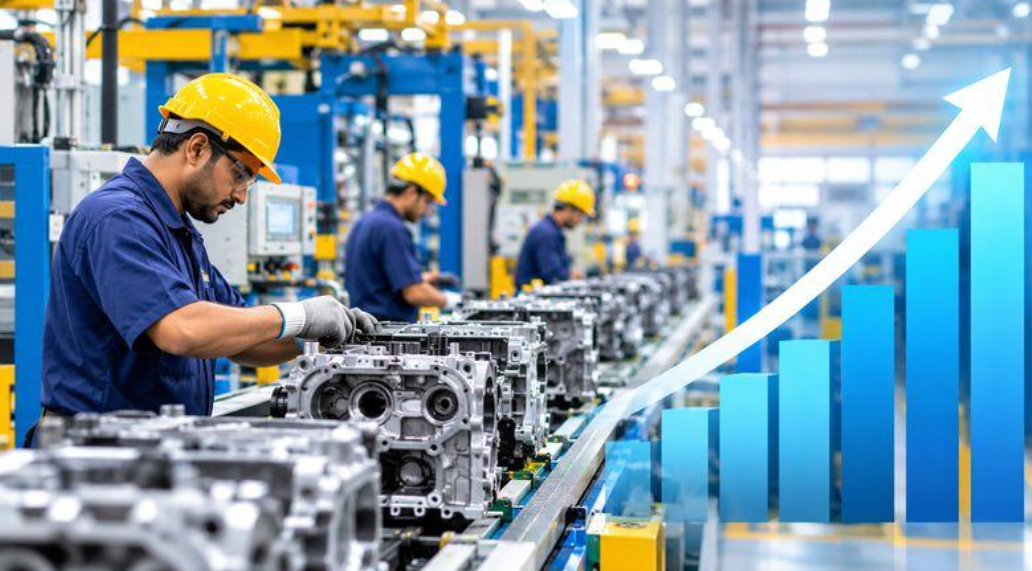
New Delhi, India’s economy is expected to have maintained a strong growth pace during the July–September quarter of 2026, with gross domestic product growth forecast at 7.6 per cent year-on-year, according to a Reuters poll of 43 economists. The estimate suggests that the country continued to expand at a relatively rapid pace despite inflationary pressures, elevated crude oil prices and uncertainty in the global economic environment. The official GDP data for the quarter is scheduled to be released on November 30, meaning the 7.6 per cent figure remains a forecast rather than a confirmed result.
The estimate is important because India’s economic performance is being closely watched by policymakers, investors, businesses and global financial institutions. Strong growth can support employment, investment and government revenue. However, the sustainability of that growth depends on several factors, including household consumption, industrial production, private investment, agricultural performance and inflation.
The economy expanded by 7.8 per cent in the April–June quarter. The Reuters poll’s median forecast of 7.6 per cent for July–September points to a modest moderation, while still indicating a strong pace of expansion compared with many major economies. The forecasts in the poll ranged from 6.6 per cent to 8.2 per cent, highlighting the uncertainty surrounding the final estimate.
Domestic consumption remains a key growth driver
Household consumption is one of the most important components of India’s economic activity. Spending on vehicles, consumer goods, housing, food, travel and services creates demand for businesses and supports production across several industries.
Recent indicators, including passenger vehicle sales and bank credit growth, have suggested that consumer demand remained resilient during the September quarter. Economists have also pointed to the support provided by earlier tax measures and household borrowing.
The strength of consumption is particularly important because India has a large domestic market. Businesses that serve Indian consumers can continue to generate revenue even when global demand weakens. Strong domestic demand can encourage companies to increase production, expand distribution networks and invest in additional capacity.
However, higher spending does not necessarily mean that every household is financially comfortable. Inflation in food, fuel, housing and other essential expenses can reduce disposable income. Some households may also be relying more heavily on credit to maintain consumption. This makes household debt and repayment capacity important indicators to monitor.
Manufacturing activity provides additional support
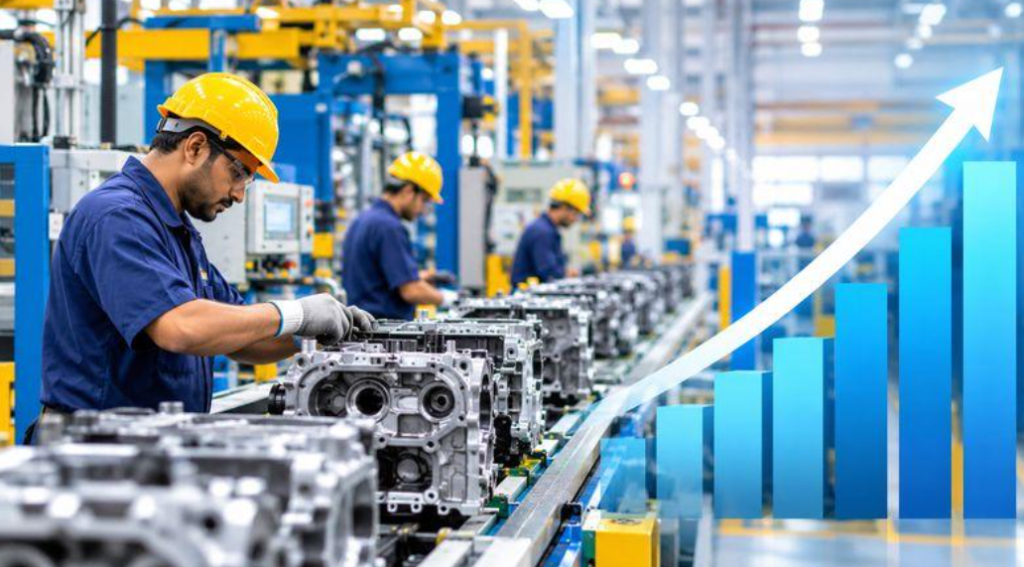
Manufacturing is a major source of employment, investment and industrial output. Growth in manufacturing can benefit not only factories but also suppliers, transport companies, logistics providers, packaging businesses and service providers.
A separate poll conducted by The Financial Express among 12 economists projected GDP growth of 7.7 per cent for the July–September quarter. It identified strong manufacturing activity and domestic consumption as key contributors. The report also noted that industrial production growth, measured through the Index of Industrial Production, increased to 7.3 per cent in the September quarter from 6.2 per cent in April–June.
The manufacturing sector’s performance matters because sustained production growth can lead to higher capacity utilisation and new investment. If companies believe that demand will remain strong, they may purchase machinery, expand factories and hire additional workers.
Nevertheless, long-term manufacturing competitiveness requires more than a temporary increase in output. Companies need reliable electricity, efficient transport infrastructure, skilled workers, access to finance and predictable regulatory conditions. Export competitiveness is also important because international markets can provide additional demand beyond domestic consumption.
Government capital expenditure and private investment
Investment is another important component of economic growth. Government spending on roads, railways, ports, airports, power infrastructure and urban development can stimulate demand across several industries.
Infrastructure projects create direct demand for construction materials, engineering services, machinery and transport. They can also improve productivity by reducing travel times, logistics costs and supply-chain delays.
Private investment is equally important for sustaining growth over the medium term. Businesses are more likely to invest when they have confidence in future demand, policy stability and the potential return on new projects.
Economists participating in the Reuters poll pointed to stronger corporate earnings and sustained government capital spending as factors supporting signs of improvement in private investment.
The key question is whether this improvement translates into actual projects, new production capacity and employment. Announcements and investment plans are useful indicators, but the broader economic impact becomes clearer when projects are completed and operations begin.
Inflation and crude oil remain major risks
India’s dependence on imported crude oil makes international energy prices an important factor for the domestic economy. When global oil prices rise, the country’s import bill can increase. Higher energy costs can affect transport, manufacturing, logistics and household budgets.
The Reuters report noted that elevated crude oil prices linked to tensions in West Asia have added to inflationary pressures. At the same time, consumption has remained relatively resilient. StreetInsider.com
Higher energy prices can affect businesses in different ways. Companies may pass some of the additional costs on to consumers through higher prices. If they are unable to do so because of competition or weak demand, their profit margins may come under pressure.
For households, higher fuel and transport costs can reduce the money available for discretionary purchases. This may eventually affect demand for consumer goods, travel and other services.
Agriculture and monsoon-related uncertainty
Agriculture remains important to India’s economy because it supports rural employment, food supply and demand in villages and smaller towns. Agricultural performance also influences food inflation, which can have a direct impact on household budgets.
The Reuters poll identified agriculture as a weak area in the economic outlook. Some estimates suggested that agricultural growth could remain close to zero in the July–September quarter. The impact of deficient rainfall and weather-related uncertainty may become more visible in subsequent agricultural activity.
he key question is whether this improvement translates into actual projects, new production capacity and employment. Announcements and investment plans are useful indicators, but the broader economic impact becomes clearer when projects are completed and operations begin.
Inflation and crude oil remain major risks
India’s dependence on imported crude oil makes international energy prices an important factor for the domestic economy. When global oil prices rise, the country’s import bill can increase. Higher energy costs can affect transport, manufacturing, logistics and household budgets.
The Reuters report noted that elevated crude oil prices linked to tensions in West Asia have added to inflationary pressures. At the same time, consumption has remained relatively resilient. StreetInsider.com
Higher energy prices can affect businesses in different ways. Companies may pass some of the additional costs on to consumers through higher prices. If they are unable to do so because of competition or weak demand, their profit margins may come under pressure.
For households, higher fuel and transport costs can reduce the money available for discretionary purchases. This may eventually affect demand for consumer goods, travel and other services.
Agriculture and monsoon-related uncertainty
Agriculture remains important to India’s economy because it supports rural employment, food supply and demand in villages and smaller towns. Agricultural performance also influences food inflation, which can have a direct impact on household budgets.
The Reuters poll identified agriculture as a weak area in the economic outlook. Some estimates suggested that agricultural growth could remain close to zero in the July–September quarter. The impact of deficient rainfall and weather-related uncertainty may become more visible in subsequent agricultural activity.