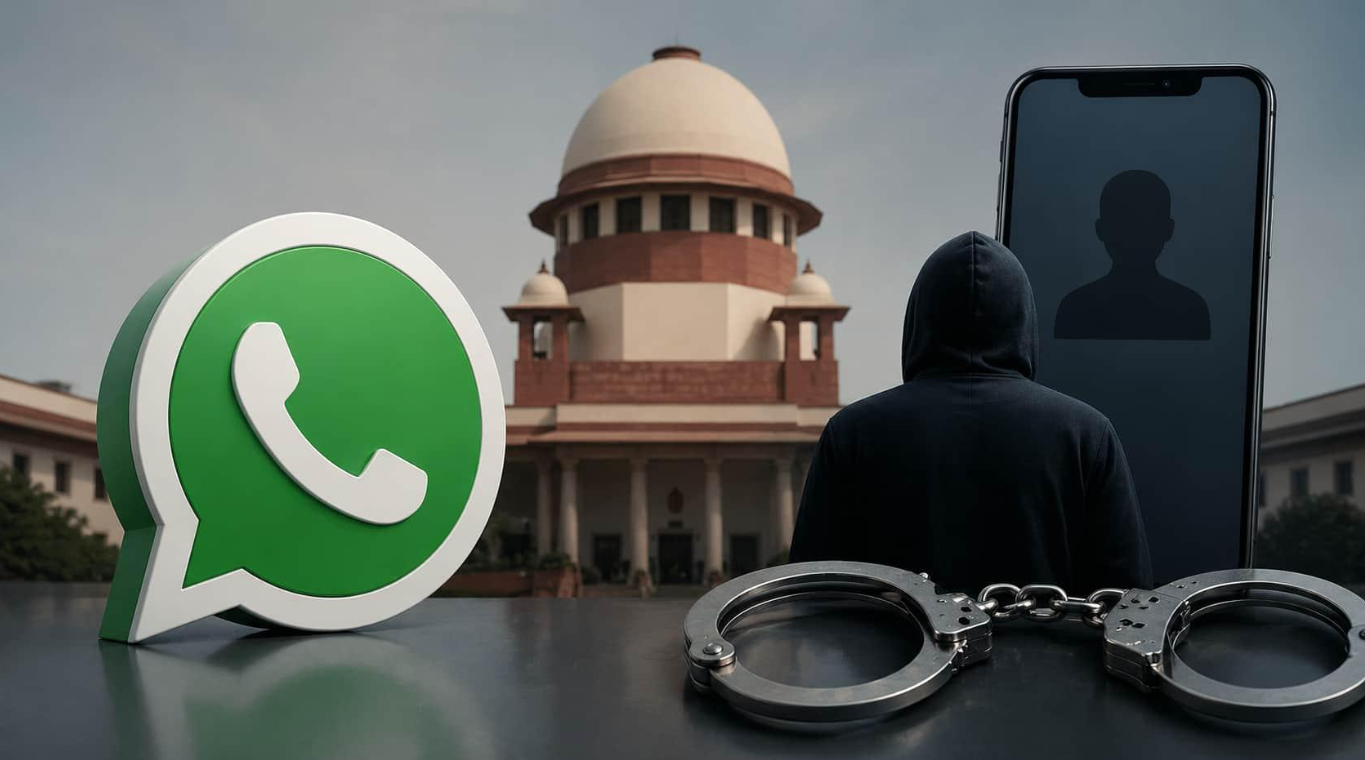
Supreme Court Cracks Down on Digital Arrest Scams
|
Getting your Trinity Audio player ready...
|
New Delhi, November 11, 2026: The Supreme Court of India has taken significant steps to address the growing problem of digital arrest scams and online financial fraud, directing WhatsApp and other digital intermediaries to explain the preventive measures they propose to introduce.
The court has also emphasised the responsibility of banks and financial institutions in preventing cyber-enabled financial crimes, stating that victims should receive compensation where an investigation establishes that fraud occurred because a financial institution failed to exercise due diligence.
The directions place renewed attention on the responsibilities of technology companies, banking institutions and law enforcement agencies in protecting citizens from increasingly sophisticated online scams.
The development follows a Supreme Court hearing held on October 29, 2026, in a suo motu case concerning victims of digital arrest involving forged documents. The order was subsequently made public in November.
How Did the Case Reach the Supreme Court?
The proceedings are titled ‘In Re: Victims of Digital Arrest Related to Forged Documents’.
The case originated after a senior citizen couple approached the Supreme Court in 2025 following the loss of their life savings in a cyber fraud incident.
The matter highlighted the growing use of impersonation, fabricated government documents and threats of arrest to force victims into transferring money to accounts controlled by cybercriminals.
Considering the seriousness of the issue, the Supreme Court initiated proceedings to examine the broader institutional and regulatory failures that may allow such crimes to continue.
The three-judge bench was headed by Chief Justice of India Surya Kant and included Justice Joymalya Bagchi and Justice V. Mohana.
The court’s intervention has expanded the discussion beyond individual fraudsters to include the responsibilities of digital intermediaries, banks, regulators and law enforcement authorities.
What Is a Digital Arrest Scam?
A digital arrest scam is a form of cyber fraud in which criminals impersonate law enforcement officers or government officials to intimidate individuals.
Fraudsters may claim to represent agencies such as the police, Central Bureau of Investigation, Enforcement Directorate or customs authorities.
Victims are often informed that their names, identity documents, bank accounts or mobile numbers have been linked to criminal investigations.
The criminals may then use fake arrest warrants, fabricated official documents and video calls to make their claims appear genuine.
In several reported methods, victims are pressured to remain on video calls, avoid contacting family members and transfer money under the pretext of verification or financial security.
Importantly, there is no legal procedure in India known as a digital arrest. Genuine law enforcement agencies do not conduct arrests by demanding money through video calls or personal bank transfers.
Supreme Court Asks WhatsApp to Submit Preventive Measures
One of the central aspects of the Supreme Court’s order concerns the role of WhatsApp and other online intermediaries.
The court directed WhatsApp LLC, a Meta company, and other concerned digital platforms to inform the court about the preventive measures they propose to undertake against digital arrest scams and related cybercrimes.
The platforms have also been directed to submit their proposals to the Indian Cyber Crime Coordination Centre (I4C).
During the proceedings, senior advocate Kapil Sibal, appearing for WhatsApp, informed the bench about the platform’s existing anti-fraud efforts.
According to reports of the hearing, WhatsApp had taken action against approximately 9,400 accounts reportedly associated with digital arrest scams and impersonation of law enforcement agencies.
The platform also indicated that it was developing software to identify suspicious accounts and provide warnings to users.
WhatsApp is expected to submit an affidavit explaining its preventive initiatives and proposed safeguards.
The court’s intervention highlights the growing importance of technology platforms in detecting fraudulent accounts, identifying impersonation attempts and protecting users from financial exploitation.
Supreme Court Raises Questions About Bank Accountability
Another major aspect of the proceedings concerns the responsibility of banks and financial institutions.
The court has emphasised that banks have access to customers’ transaction histories and should use this information to identify suspicious financial activity.
For example, if an account that normally conducts small transactions suddenly attempts to transfer an unusually large amount to an unfamiliar account, the bank should have appropriate mechanisms to identify and examine the activity.
The Supreme Court reiterated that regulatory measures proposed by the Reserve Bank of India should incorporate provisions requiring financial institutions to compensate victims where investigations establish that the fraud occurred because the institution failed to exercise due diligence.
The proposed compensation should not be less than the amount lost by the customer in cases meeting that condition.
This is an important distinction: the court has not established automatic compensation for every cyber fraud victim. The responsibility of a financial institution depends on the findings concerning its failure to exercise due diligence.
What Preventive Measures Should Banks Introduce?
The Supreme Court has highlighted several safeguards that financial institutions should consider implementing.
1. Detection of unusual transactions
Banks should identify transactions that are inconsistent with the customer’s previous account activity and usual financial behaviour.
2. Temporary suspension of suspicious transactions
Appropriate mechanisms should be introduced to temporarily suspend unusual or suspicious transactions where necessary.
3. Automatic notification to authorities
Suspicious transactions should be reported to the nearest police station through an appropriate notification mechanism.
4. Verification of financial activity
Banks should introduce systems for verifying the authenticity of suspicious transactions before allowing potentially fraudulent transfers to proceed.
5. Compensation and accountability
Regulatory provisions should ensure that financial institutions are held accountable when their failure to exercise due diligence is established as a contributing factor in the fraud.
These measures are intended to strengthen the banking system’s ability to detect and interrupt fraudulent financial transfers before victims lose their money.
More Than ₹647 Crore Involved in Digital Arrest Complaints During the First Eight Months of 2026
Information presented by the Union government before the court highlighted the scale of the problem.
According to the reported government data, India’s cybercrime portal received 21,928 digital arrest-related complaints during the first eight months of 2026.
The complaints involved more than ₹647 crore.
The figures demonstrate the financial scale of reported digital arrest scams and the need for stronger preventive measures.
However, the reported amount represents the value involved in complaints and should not automatically be interpreted as the final amount of verified losses or money recovered.
States and Union Territories Asked to Submit Investigation Reports
The Supreme Court has also directed law enforcement agencies across all states and Union territories to submit information about FIRs registered in digital arrest scam cases and the investigations conducted so far.
The agencies have been asked to provide suggestions on preventing, detecting and prosecuting such offences.
The Directors General of Police of all states and Union territories have been directed to ensure compliance with the court’s instructions.
The information is also intended to support the Indian Cyber Crime Coordination Centre in coordinating the national response to cybercrime.
RBI Asked to Submit Details of Authorised Financial Institutions
To strengthen the implementation of proposed financial safeguards, the Supreme Court has directed the Reserve Bank of India to submit a list of authorised financial institutions before the next hearing.
The court is examining how regulatory measures can improve the detection of suspicious transactions, establish institutional accountability and strengthen the financial protection available to victims.
The RBI’s proposed regulatory framework and the court’s directions could have important implications for banking practices and cyber fraud prevention across the country.
Next Supreme Court Hearing on November 23, 2026
The Supreme Court has scheduled the next hearing for November 23, 2026.
The proceedings are expected to examine the proposed preventive measures from WhatsApp and other digital platforms, the RBI’s regulatory proposals and reports submitted by law enforcement agencies.
The next hearing will be important in determining how the various institutions will coordinate their efforts to prevent digital arrest scams and protect financial consumers.
What Should Citizens Do to Protect Themselves?
As digital fraud becomes increasingly sophisticated, awareness remains one of the most important forms of protection.
Citizens should avoid sharing OTPs, UPI PINs, passwords or banking credentials with unknown callers.
They should also remember that no genuine police officer or government agency can demand money through a personal bank transfer to prevent an arrest.
Anyone receiving a suspicious call claiming to be from a government agency should independently verify the caller’s identity through official contact details.
Victims of financial cyber fraud in India can contact the national cybercrime helpline at 1930 and register complaints through the official portal at cybercrime.gov.in.
Conclusion
The Supreme Court’s intervention represents an important development in India’s efforts to address digital arrest scams and financial cybercrime.
By examining the responsibilities of messaging platforms, banks, regulators and law enforcement agencies together, the court has highlighted the need for a coordinated approach to digital safety.
The proceedings also underline the importance of protecting ordinary citizens who increasingly depend on online banking and digital communication in their everyday lives.
With the next hearing scheduled for November 23, 2026, attention will remain focused on the preventive measures proposed by WhatsApp, the regulatory response from the RBI and the steps being taken by law enforcement agencies across India.