Brazil Election 2026: Lula Wins Fourth Presidential Term, Defeats Flávio Bolsonaro in Runoff
|
Getting your Trinity Audio player ready...
|
Official results declared 30 October 2026
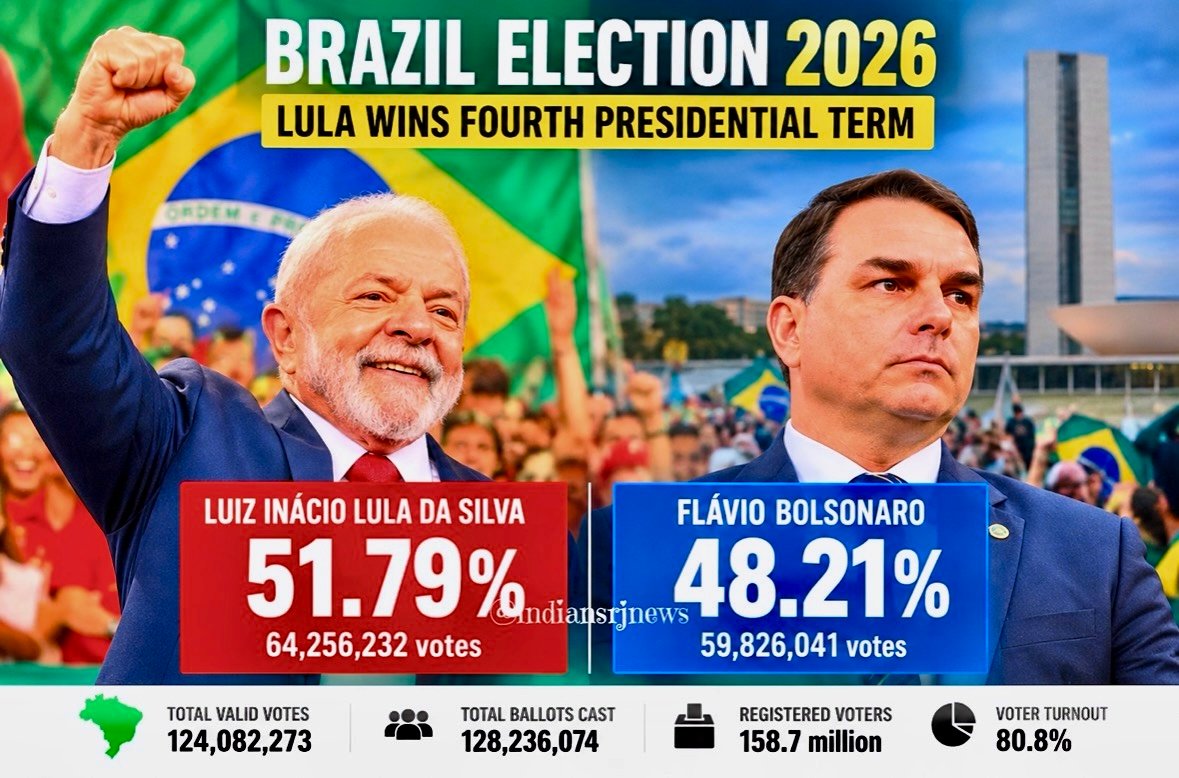
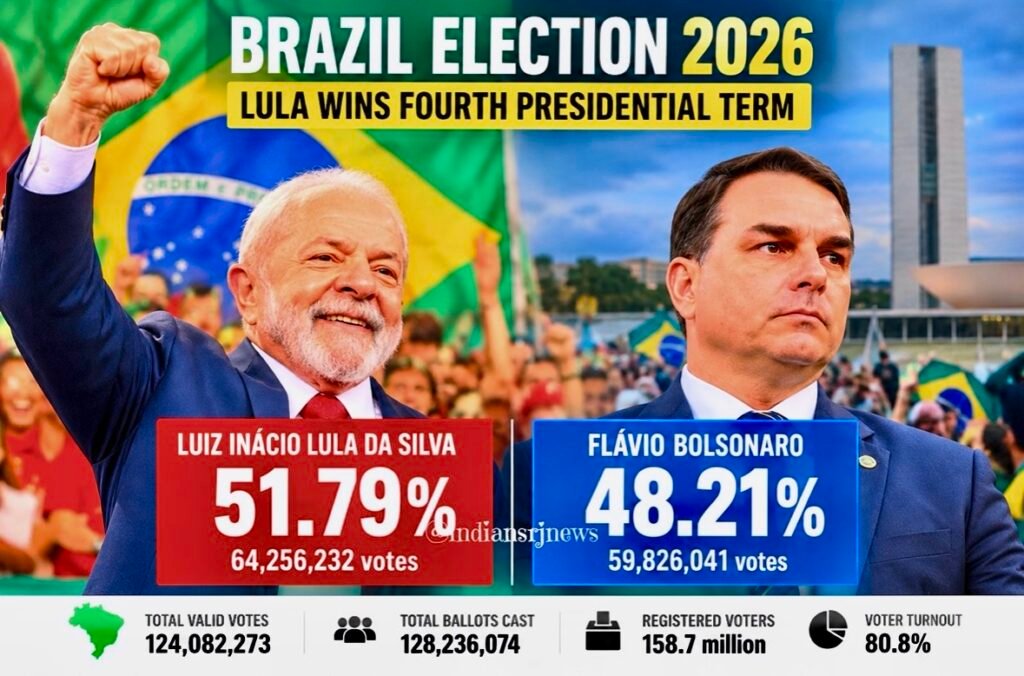
Brasília: Brazil’s presidential election has concluded with incumbent President Luiz Inácio Lula da Silva winning a historic fourth presidential term, defeating opposition candidate Flávio Bolsonaro in the second round of voting held on October 25, 2026.
According to the country’s Superior Electoral Court (TSE), Lula secured 51.79% of valid votes, while Flávio Bolsonaro received 48.21%. The election result represents a significant political development for Brazil, Latin America’s largest economy.
Brazil Election Results 2026: Final Vote Count
The official results confirmed Lula’s victory after all polling sections were counted.
- Luiz Inácio Lula da Silva (Workers’ Party – PT): 64,256,232 votes (51.79%).
- Flávio Bolsonaro (Liberal Party – PL): 59,826,041 votes (48.21%).
- Total valid votes: 124,082,273.
- Total ballots cast: 128,236,074.
- Registered voters: Approximately 158.7 million.
- Voter turnout: Approximately 80.8%.
Lula defeated Flávio Bolsonaro by approximately 4.43 million votes.
Who is Luiz Inácio Lula da Silva?
Luiz Inácio Lula da Silva, popularly known as Lula, is a Brazilian politician and leader of the Workers’ Party (PT).
He previously served as Brazil’s president from 2003 to 2010 and returned to office in January 2023 after defeating former president Jair Bolsonaro in the 2022 election.
His latest victory gives him a fourth presidential term overall, making it a historic achievement in Brazilian politics.
Lula’s political agenda has focused on social welfare programmes, poverty reduction, economic development and strengthening Brazil’s international relations.
Who Is Flávio Bolsonaro?
Flávio Bolsonaro is a Brazilian senator and the son of former Brazilian president Jair Bolsonaro.
Representing the Liberal Party (PL), he emerged as the principal opposition candidate in the 2026 presidential election.
His campaign attracted support from conservative and right-wing voters. He also sought to continue the political legacy of his father, Jair Bolsonaro.
Flávio finished ahead of Lula in the first round but ultimately lost the presidential runoff.
First Round vs Second Round: How Lula Turned the Election Around
Brazil’s presidential election took place in two rounds because neither candidate secured more than 50% of valid votes in the first round on October 4, 2026.
In the first round, Flávio Bolsonaro received 47.03% of valid votes, while Lula secured 45.16%.
The result sent both candidates into a direct second-round contest on October 25.
However, Lula managed to reverse the first-round outcome and won the runoff with 51.79% of valid votes against Bolsonaro’s 48.21%.
Political Controversy Following the Election
Following the announcement of the results, Flávio Bolsonaro questioned the election process and called for the results to be annulled.
However, Brazil’s Liberal Party subsequently formally recognised the official vote totals certified by the Superior Electoral Court, while raising questions about certain pre-election government spending measures.
The election authority confirmed Lula as the winner.
What Happens Next in Brazil?
Following his victory, Lula is expected to continue leading Brazil for another presidential term, beginning in January 2027.
His government will face several major challenges, including economic growth, inflation, public security, social inequality and international relations.
The election is also being closely watched internationally because Brazil plays an important role in global trade, climate negotiations, agriculture and international diplomacy.
Why Is the Brazil Election 2026 Important?
Brazil is the largest country in South America and one of the world’s major emerging economies.
The presidential election is significant not only for Brazil but also for the wider Latin American region.
Lula’s victory is expected to maintain continuity in Brazil’s existing government policies, while the strong performance of Flávio Bolsonaro demonstrates the continuing political influence of conservative forces in the country.
The election has once again highlighted the political divisions between left-wing and right-wing movements in Brazil.
Conclusion: Luiz Inácio Lula da Silva has secured another presidential term after defeating Flávio Bolsonaro in a closely contested runoff. With the official results declared, Brazil now prepares for the next phase of its political and economic journey.
Disclaimer: This article is based on publicly available information and official election figures published by Brazil’s Superior Electoral Court (TSE), as of October 30, 2026.