
India Semicon 2.0: ₹1.27 Lakh Crore Mission and 12 New Projects
|
Getting your Trinity Audio player ready...
|
New Delhi, November 15, 2026: India has taken another significant step towards establishing itself as a global hub for semiconductor and electronics manufacturing. The Government of India is accelerating its semiconductor development strategy through the second phase of the Semicon India Programme, known as Semicon 2.0, with a financial outlay of ₹1,27,500 crore.
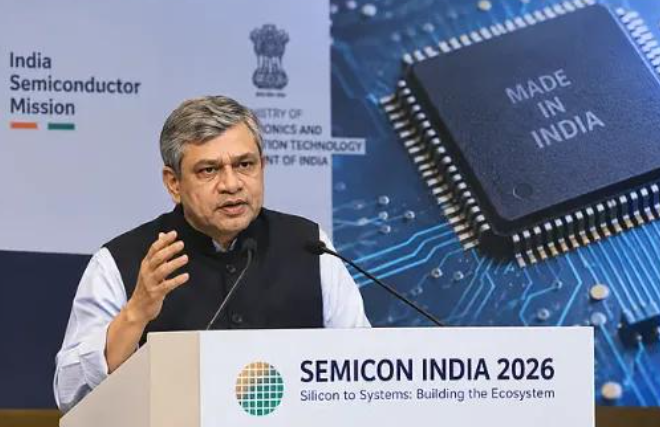
Union Minister for Electronics and Information Technology Ashwini Vaishnaw launched the Semicon 2.0 web application portal on November 6, 2026. On the same occasion, the government announced approval for 12 additional applications under the Electronics Components Manufacturing Scheme (ECMS)
The newly approved projects involve proposed investments of approximately ₹7,503 crore. They are expected to generate production worth ₹39,045 crore and create 7,127 direct employment opportunities.
The projects will be spread across Gujarat, Karnataka, Madhya Pradesh, Maharashtra, Punjab, Tamil Nadu and Uttar Pradesh. The announcement represents an important development in India’s efforts to strengthen domestic electronics manufacturing and reduce dependence on imported components.
What Is Semicon 2.0?
Semiconductors are among the most important technologies powering the modern world. They are essential components in smartphones, computers, automobiles, medical equipment, telecommunications infrastructure, defence systems, artificial intelligence and data centres.
As India’s digital economy expands, demand for advanced electronic components and semiconductor chips continues to grow. Developing a complete semiconductor ecosystem, however, requires advanced manufacturing facilities, specialised machinery, raw materials, skilled professionals and substantial investment.
Semicon 2.0 aims to address these requirements by developing an integrated domestic semiconductor industry.
The programme focuses on six strategic pillars: chip design, machinery and materials, additional semiconductor fabrication facilities, ATMP and OSAT expansion, research and development, and talent development.
Applications have opened for Pillars 2, 3 and 4 through the newly launched portal.
Six Strategic Pillars of the Mission
The first pillar focuses on chip design, encouraging Indian startups, companies and educational institutions to strengthen domestic design capabilities.
The second pillar aims to develop manufacturing capabilities for semiconductor machinery, materials, chemicals and industrial gases. These are essential inputs for advanced semiconductor factories.
The third pillar supports the establishment of additional semiconductor fabrication facilities, commonly known as fabs. These facilities manufacture chips using sophisticated processes involving silicon wafers and advanced equipment.
The fourth pillar focuses on Assembly, Testing, Marking and Packaging (ATMP) and Outsourced Semiconductor Assembly and Test (OSAT). These activities are essential for converting manufactured semiconductor chips into finished components suitable for electronic devices.
The fifth pillar promotes research and development, while the sixth focuses on developing a skilled workforce capable of supporting the industry’s long-term growth.
12 New Projects Approved Under ECMS
The latest approvals cover 10 product segments across electronic components, supply-chain materials and capital goods.
The approved products include multilayer printed circuit boards, relays, heat sinks, speciality ceramics, copper foil, lithium-ion battery anode material, cathode active material, polypropylene film and camera rims.
NeST ICELR Private Limited has received approval for multilayer PCB manufacturing, while TDConnex (Chennai) Private Limited has been approved for relay manufacturing.
Modern Automotives Limited will manufacture heat sinks, and Voltix Semicon Private Limited has received approval for speciality ceramics.
In the supply-chain category, Indo Asia Copper Limited will manufacture copper foil, TACC Limited will produce anode material, and Vidyuta Materials Private Limited will manufacture cathode active material.
Enerfolie LLP has received approval for polypropylene film, while Surface Modification Technologies Pvt. Ltd. will manufacture camera rims.
The approvals also cover industrial machinery and factory automation equipment, including projects involving Rockwell Automation India and Wipro Pari Robotics.
Importantly, the latest approvals include first-time ECMS approvals for copper foil, cathode active material and speciality ceramics.
ECMS Investment Reaches ₹77,051 Crore
With the latest 12 approvals, the total number of approved applications under ECMS has reached 118.
According to government figures, these applications represent proposed investments of ₹77,051 crore, projected production worth ₹5,73,146 crore and an estimated 81,755 direct employment opportunities.
The approved projects cover 34 product categories across 16 states.
These figures represent projected outcomes rather than completed investments or employment already generated. Their actual impact will depend on project implementation, construction, production and market demand.
Opportunities for MSMEs and Indian Manufacturers
Micro, Small and Medium Enterprises (MSMEs) are expected to play an important role in India’s electronics manufacturing expansion.
A modern electronic device requires hundreds of components, including circuit boards, connectors, battery materials, thermal management systems and specialised electronic parts.
Domestic manufacturing of these components can create opportunities for smaller suppliers to become part of larger industrial supply chains.
The government has highlighted that nearly 50 per cent of the approved units under the scheme belong to the MSME sector.
This could encourage technology development, industrial investment and employment opportunities across different regions.
India’s Semiconductor Journey So Far
Under the first phase of the Semicon India Programme, 12 projects were approved across six states, involving cumulative investments exceeding ₹1.64 lakh crore.
Five of these projects had commenced commercial production by October 2026, according to the government.
India is also investing in semiconductor design capabilities. As part of the development programme, 105 startups have received access to Electronic Design Automation tools, 24 startups have received funding support, and 15 have secured venture capital funding.
Under the Chips to Startup Programme, 332 institutions have been provided with EDA tools, while approximately 70,000 students have received training.
These initiatives aim to develop domestic expertise rather than relying entirely on foreign technology providers.
Why Semiconductor Manufacturing Matters for India’s Economy
Semiconductor manufacturing is increasingly important for economic competitiveness and national security.
Countries around the world are seeking more resilient supply chains for essential electronic components. India has the potential to become an important manufacturing destination because of its large domestic market, engineering talent, growing digital economy and industrial development ambitions.
However, establishing a competitive semiconductor industry will require long-term investment, reliable electricity, high-quality water, specialised machinery, research capabilities and consistent technological development.
India will also need to compete with established semiconductor manufacturing economies such as Taiwan, South Korea, Japan, China and the United States.
Will It Make Smartphones and Electronics Cheaper?
The expansion of domestic electronics manufacturing could eventually benefit consumers by reducing dependence on imported components and improving supply-chain reliability.
However, the new approvals do not mean that smartphone or laptop prices will immediately decrease.
The final price of an electronic product depends on several factors, including semiconductor costs, displays, batteries, imported materials, logistics, currency movements, taxes and manufacturing expenses.
Any potential consumer benefit will depend on the scale of domestic production, manufacturing efficiency and competition.
What Lies Ahead?
The launch of Semicon 2.0 and the latest ECMS approvals represent an important step in India’s technology and industrial development strategy.
The next major challenge will be converting investment announcements into operational factories, actual production, technological innovation and sustainable employment.
The success of the mission will depend on implementation, industry participation, research capabilities, skilled manpower and the ability of Indian manufacturers to compete internationally.
If these objectives are achieved, India could strengthen its position in the global semiconductor and electronics supply chain over the coming years.
The broader ambition is to transform India from a major consumer of electronic products into a significant producer of advanced electronic components, semiconductor technologies and manufacturing equipment.


