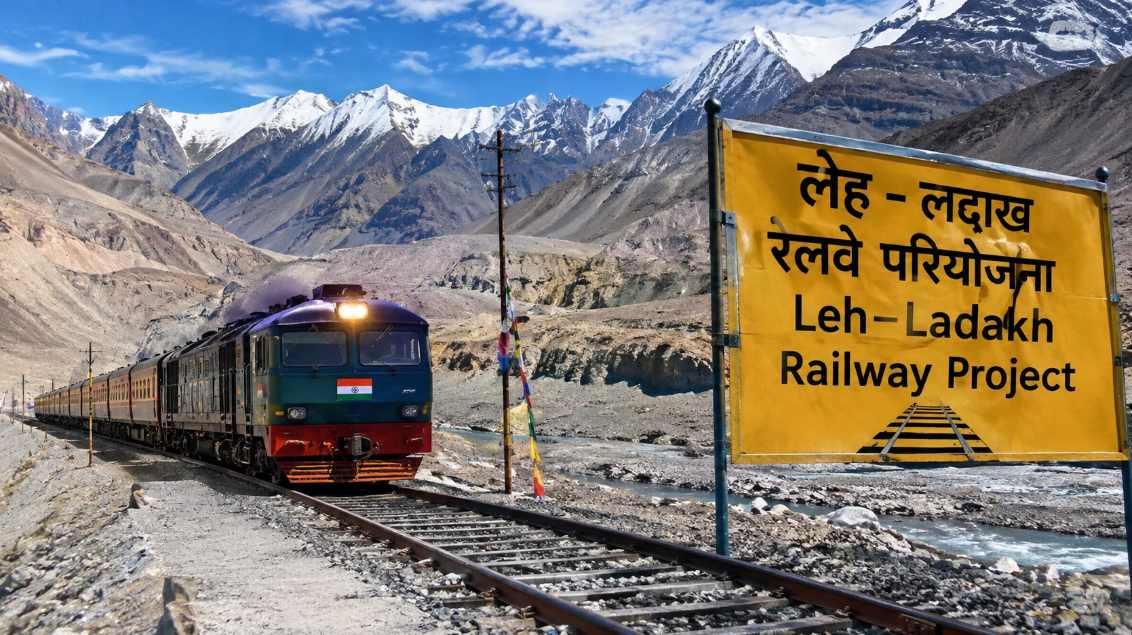
Railway Connectivity from Punjab to Leh: ₹1.31 Lakh Crore Railway Corridor
|
Getting your Trinity Audio player ready...
|
New Delhi: India is planning one of its most ambitious railway infrastructure projects to improve connectivity to the strategically important Ladakh region. The proposed Bhanupali–Bilaspur–Manali–Leh railway corridor aims to connect Punjab with Leh through the mountainous terrain of Himachal Pradesh.
According to information provided by the Ministry of Railways, the Detailed Project Report (DPR) for the 489-kilometre Bilaspur–Manali–Leh railway section has been prepared. The estimated project cost stands at approximately ₹1.31 lakh crore, with around 270 kilometres of tunnels proposed along the route.
Railway Connectivity from Punjab to Leh
The broader proposed railway corridor is planned to begin at Bhanupali in Punjab and extend through Himachal Pradesh before reaching Leh in Ladakh.
The 489-kilometre Bilaspur–Manali–Leh section is expected to pass through Beri, Sundernagar, Mandi, Manali, Sissu, Darcha, Keylong, Sarchu, Pang, Rumtse, Upshi and Kharu before terminating at Leh.
The corridor is expected to provide rail connectivity to several important towns in the Himalayan region.
Around 270 KM of Tunnels Planned
One of the biggest engineering challenges of the project is the difficult Himalayan terrain.
The proposed railway alignment includes approximately 270 kilometres of tunnels. Engineers will have to deal with complex geological formations, extreme weather conditions, high-altitude construction requirements and challenging mountain landscapes.
The extensive tunnelling requirement makes this one of India’s most technically demanding proposed railway projects.
Potential World’s Highest Railway Station
Another major feature of the proposed project is a railway station planned beneath the Tanglang La region at an elevation of approximately 5,256 metres above sea level.
If constructed according to the proposed alignment, the station could become the world’s highest railway station, surpassing China’s Tanggula railway station.
This would represent a significant achievement in high-altitude railway engineering.
Strategic Importance for National Security
Ladakh holds considerable strategic importance because of its geographical location along India’s northern borders.
At present, road and air transport are the primary means of reaching the region. A railway connection could provide an additional transportation option for passengers, essential supplies and freight.
The Ministry of Defence has identified the Bilaspur–Manali–Leh corridor as a strategic railway project. Its eventual implementation could strengthen transport and logistical connectivity to the region.
Has Construction Started?
The railway survey has been completed and the Detailed Project Report has been prepared. However, the proposed Bilaspur–Manali–Leh railway corridor has not yet received all the necessary final approvals for construction.
The associated 63-kilometre Bhanupali–Bilaspur–Beri railway project has also faced challenges involving land acquisition and financial contributions. In October 2026, the Himachal Pradesh High Court quashed a preliminary land acquisition notification related to this project.
Therefore, the completion of the DPR should not be interpreted as confirmation that construction has begun.
A Major Infrastructure Vision for Ladakh
If approved and successfully implemented, the proposed railway corridor could transform transportation connectivity between Punjab, Himachal Pradesh and Ladakh.
It could support tourism, regional trade, passenger movement and strategic logistics. However, the project’s enormous estimated cost, extensive tunnelling requirements and difficult Himalayan terrain will make its implementation a major challenge.
For now, the project remains at the planning and approval stage, with no officially confirmed construction commencement or passenger-service date.
Conclusion: The proposed Bhanupali–Bilaspur–Manali–Leh railway corridor represents a major infrastructure vision for India’s Himalayan region. Its eventual development could mark a historic milestone in connecting Ladakh with the national railway network.