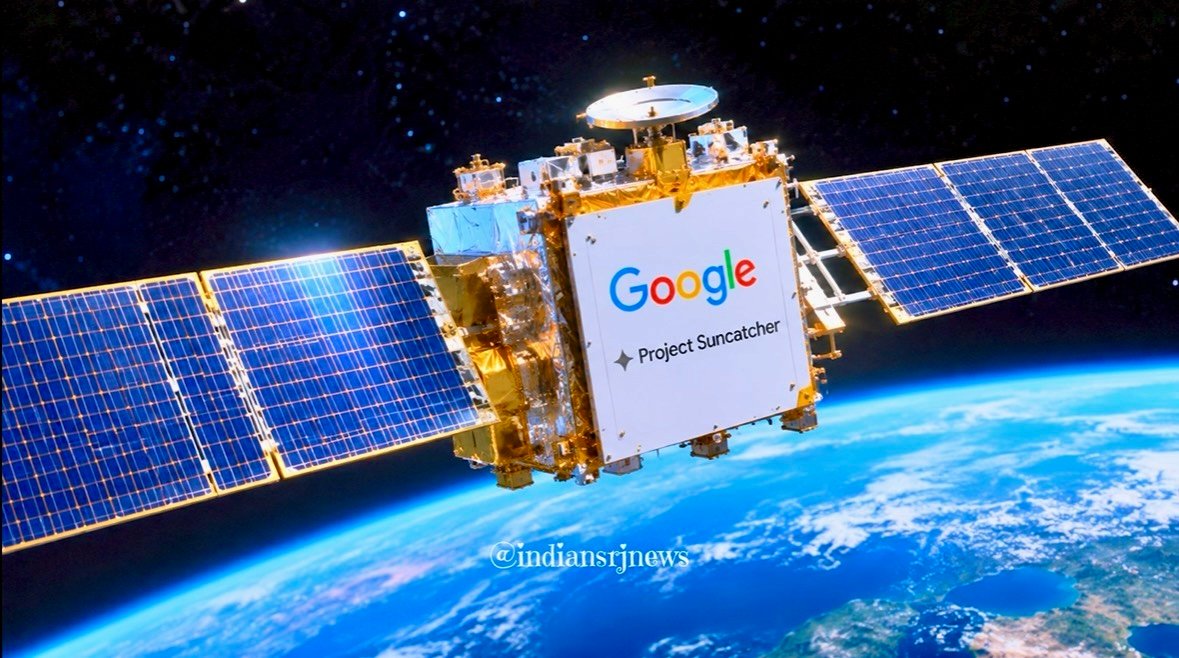
Google Is Testing AI Data Centers in Space!
|
Getting your Trinity Audio player ready...
|
November 2, 2026
What If the Future of Artificial Intelligence Is Beyond Earth?
Artificial intelligence is expanding rapidly, but the technology requires enormous computing power, electricity, and cooling infrastructure. As technology companies continue building larger data centres on Earth, Google is exploring a rather extraordinary possibility: moving some of the infrastructure needed to run artificial intelligence into space.
In a major development announced on October 30, 2026, Google confirmed that its experimental Project Suncatcher satellite had successfully generated its first AI response while operating in Earth’s orbit.
The achievement is significant because it demonstrates that an AI model can receive an instruction from Earth, process it using computing hardware aboard a satellite, and transmit the result back to a ground station.
The experiment is an early milestone in Google’s long-term research into space-based computing infrastructure. It does not mean that Google has already built a fully operational data centre in space, but it demonstrates that some of the underlying technology can work outside Earth’s atmosphere.
What Exactly Is Google’s Project Suncatcher?
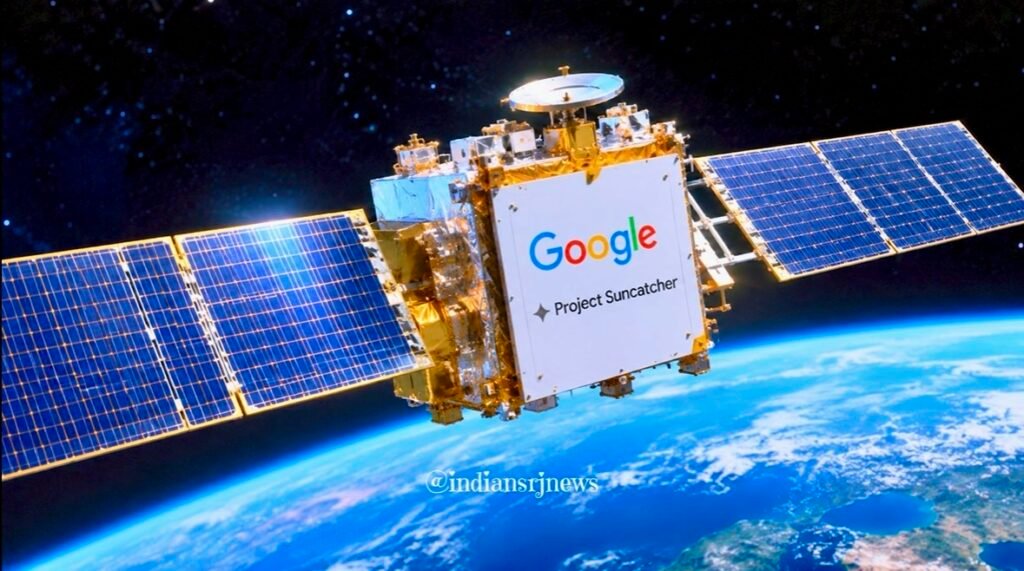
Project Suncatcher is Google’s experimental research initiative exploring whether large-scale machine learning infrastructure could eventually operate in space.
The basic idea is to place specialised computing hardware aboard satellites equipped with solar panels.
These satellites could potentially use sunlight to generate electricity and communicate with one another through high-speed optical links.
Google believes that future space-based computing systems could offer an alternative way to provide the enormous computing capacity required by increasingly advanced AI models.
The project is being developed with satellite company Planet.
Google launched its prototype satellite on October 1, 2026, aboard SpaceX’s Transporter-18 rideshare mission.
The satellite entered orbit successfully, and Google confirmed communication with the spacecraft following its launch.
How Did Google’s Satellite Generate Its First AI Response?
The breakthrough occurred after several weeks of initial testing and system commissioning.
Google engineers activated the onboard computing hardware and conducted early machine-learning experiments.
The satellite carries four Google Tensor Processing Units (TPUs), which are specialised chips designed to accelerate artificial intelligence workloads.
For the demonstration, engineers sent a prompt to the satellite’s onboard Gemma 4 open AI model.
The instruction was simple: generate a haiku about being in space.
As the satellite passed over Svalbard, Norway, the system transmitted its AI-generated response back to Earth through a ground station.
The resulting poem was:
“Blue marble below
Data streams in silent grace
Starlight feeds my core.”
Although the task was relatively simple, the technical achievement was important. The AI model processed the instruction aboard the satellite rather than relying entirely on a conventional terrestrial data centre to perform the computation.
Google described this as the first AI response from a data-centre-class TPU operating in orbit.
What Technology Is Inside the Satellite?
One of the most interesting aspects of Project Suncatcher is its onboard computing hardware.
The prototype contains four Google TPUs, specialised processors used for machine-learning tasks.
These chips are designed to accelerate the mathematical operations required by modern AI systems.
The satellite also contains solar panels that generate electricity to operate its onboard systems.
However, the available power is limited.
According to technical reporting, the satellite can operate only one TPU at a time for a limited period of approximately 20 minutes.
This is an important limitation because large AI data centres on Earth typically use thousands of processors operating together.
Google is therefore not attempting to replace conventional data centres immediately. It is testing whether space-based computing can become technically practical over the longer term.
Why Does Google Want to Build Data Centres in Space?
The rapid growth of artificial intelligence has increased demand for computing infrastructure.
Modern AI systems require powerful processors, electricity, cooling equipment and large buildings to house data-centre hardware.
This creates several challenges for technology companies.
1. Increasing Electricity Demand
AI data centres require substantial amounts of electricity. As AI adoption grows, energy demand is becoming a major infrastructure challenge.
2. Cooling Requirements
Powerful processors generate considerable heat. Data centres need advanced cooling systems to prevent hardware from overheating.
3. Land and Infrastructure
Large data centres require extensive land, electrical connections, networking infrastructure and access to reliable power supplies.
4. Solar Energy Opportunities
In orbit, satellites can potentially access sunlight through solar panels. Google is investigating whether this could support future computing infrastructure.
However, generating solar electricity in space does not automatically make orbital data centres cheaper or easier to operate.
Launching hardware, protecting it from radiation, managing heat and maintaining communication links remain major engineering challenges.
The Biggest Challenge: Cooling AI Chips in Space
One of the most difficult aspects of building a data centre in orbit is thermal management.
On Earth, conventional data centres can use fans, air conditioning and liquid-cooling systems to remove heat from powerful processors.
Space presents a different engineering environment.
Because there is no surrounding air in a vacuum, conventional air-based cooling cannot work in the same way.
Engineers must instead rely on carefully designed thermal systems that transfer heat away from electronic components and radiate it into space.
Google’s experiment will examine how its TPUs perform under extreme thermal conditions and radiation exposure.
Radiation is another serious concern because energetic particles can interfere with electronic circuits and potentially corrupt data.
The satellite therefore provides an opportunity to test real hardware in the environment where future orbital data centres would need to operate.
What Is the Next Step for Project Suncatcher?
Google has indicated that its next major milestone is to test two interconnected satellites in 2027.
These satellites are expected to help demonstrate how multiple spacecraft could communicate and work together.
The proposed architecture involves high-speed optical communication links between satellites.
If successful, such a system could allow computing workloads to be distributed across multiple spacecraft rather than relying on a single satellite.
This would be an important step towards testing larger orbital computing networks.
However, the 2027 milestone remains part of Google’s development plan. It should not be confused with the commercial deployment of a fully operational space data centre.
Is Google the Only Company Exploring AI in Space?
No. Several companies are investigating the possibility of operating computing hardware beyond Earth.
Startups and technology companies are exploring satellite-based computing, specialised AI processors and communication networks.
One example is Starcloud, which has demonstrated AI computing using satellite hardware.
The broader interest in space-based computing reflects a growing recognition that future AI infrastructure may require new approaches to energy generation, computing capacity and data transmission.
Competition in this emerging field could accelerate research into satellite hardware, advanced cooling systems and high-speed communication technologies.
Could Space Data Centres Change the Future of AI?
If experiments such as Project Suncatcher eventually become commercially successful, they could introduce a new category of computing infrastructure.
Potential applications could include:
- Processing satellite imagery directly in orbit.
- Analysing environmental and climate observations.
- Supporting space-based scientific research.
- Processing large volumes of Earth-observation data.
- Creating interconnected networks of AI-powered satellites.
For example, an Earth-observation satellite could potentially process images before transmitting selected results to ground stations.
This might reduce the need to transmit large quantities of raw data back to Earth.
However, whether such systems can compete economically with terrestrial data centres remains an open question.
Launch expenses, hardware replacement, radiation protection, thermal management and network reliability must all be considered.
Conclusion: A New Chapter in the Future of Computing
Google’s Project Suncatcher represents an interesting milestone in the development of artificial intelligence and space technology.
The successful generation of an AI response by a satellite in orbit demonstrates that specialised computing hardware can perform machine-learning tasks beyond Earth’s atmosphere.
However, the project remains experimental. Its current capabilities are limited by power availability, thermal management and the challenges of operating electronic systems in space.
The next stage of testing will be important in determining whether interconnected orbital computing systems can become technically and economically viable.
If the technology develops successfully over the coming years, the future of AI infrastructure may extend beyond traditional buildings and data centres on Earth.
The question is no longer simply how powerful artificial intelligence can become, but also where the computers powering it could operate in the future.
Disclaimer: This article is intended for informational and educational purposes only. It is based on Google’s published announcements and publicly available technology reports as of November 2, 2026. Project Suncatcher is an experimental research initiative, not a fully operational commercial space data centre.