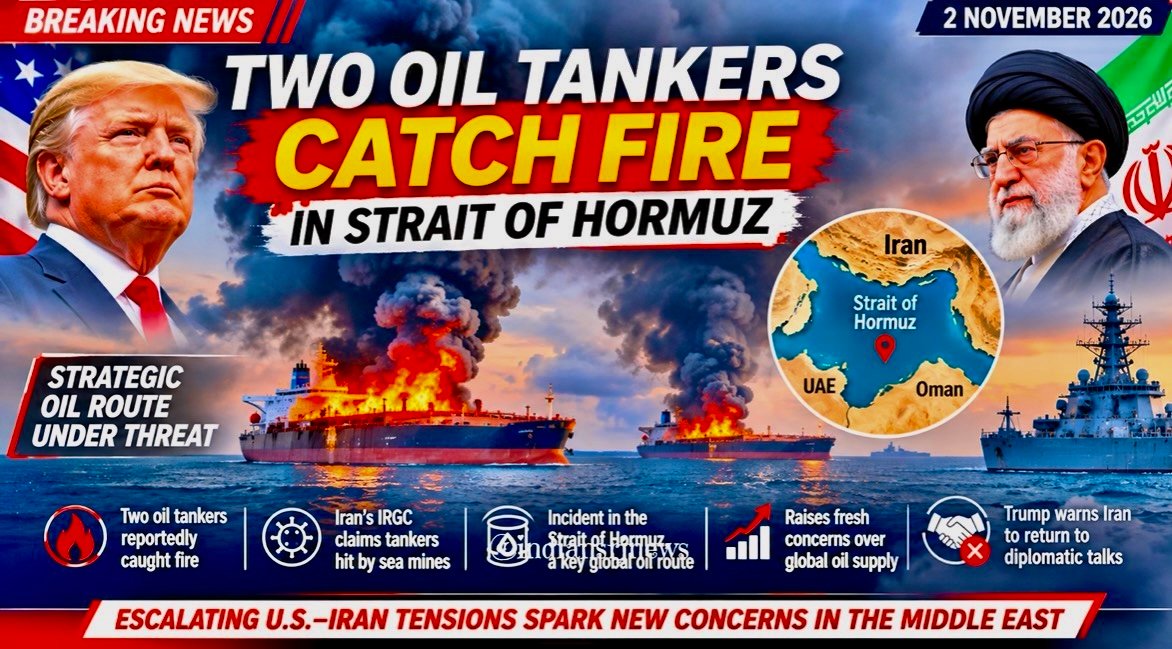
Two Oil Tankers Reportedly Catch Fire in Strait of Hormuz
|
Getting your Trinity Audio player ready...
|
November 2, 2026
Fresh Maritime Security Concerns in the Middle East
The Strait of Hormuz has once again become the centre of international attention following reports of two oil tankers catching fire in the strategically important waterway amid escalating tensions between Iran and the United States.
On November 1, Iran’s Islamic Revolutionary Guard Corps (IRGC) Navy claimed that two oil tankers had exploded after striking naval mines while attempting to pass through what Tehran described as an unauthorised shipping route.
The development was reported by Iranian state media and subsequently covered by international news organisations. However, the precise circumstances of the reported explosions have not been independently verified.
The incident comes at a particularly sensitive time, as commercial shipping companies are already facing security concerns, restrictions on maritime movement and rising insurance costs across the Gulf region.
For the international community, the situation raises an important question: could the growing confrontation around the Strait of Hormuz create another major disruption to global energy supplies?
What Exactly Happened on November 1?
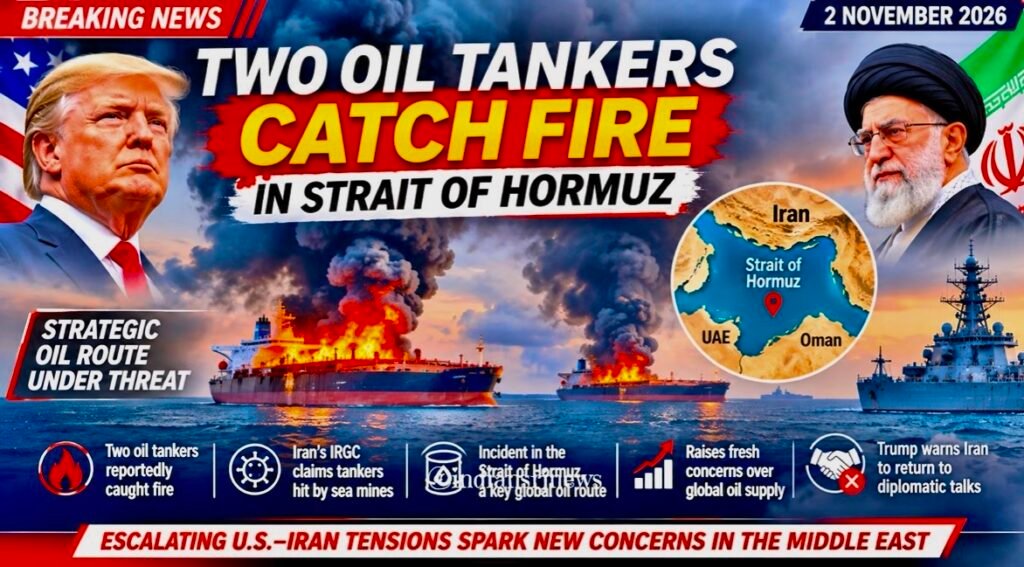
According to a statement attributed to the IRGC Navy and reported by Iranian state media on Sunday, November 1, two oil tankers encountered naval mines while attempting to navigate through an unauthorised route in the Strait of Hormuz.
Iranian authorities claimed that both vessels suffered explosions after striking mines.
The IRGC also alleged that the ships had switched off their navigation and identification systems in an attempt to pass through the restricted maritime corridor.
One of the vessels was reportedly described as a supertanker, with Iranian officials claiming that it was engulfed in flames following a powerful explosion.
Tehran presented the incident as a violation of its maritime restrictions and argued that vessels attempting to bypass its rules would face serious consequences.
However, several important details remain unclear.
The names of both tankers, their registered countries, ownership, cargo origins and the exact number of crew members aboard have not been independently established in the available reporting.
Most importantly, Reuters reported that it could not independently verify the IRGC’s account of the two explosions.
Therefore, the claims should be treated as statements from Iranian authorities rather than independently established facts.
What Has the UK Maritime Security Agency Reported?
Another important development came from the United Kingdom Maritime Trade Operations (UKMTO), an organisation that provides maritime security information to commercial shipping.
On November 1, UKMTO received a report concerning an incident inside the Strait of Hormuz.
According to its advisory, the master of a merchant vessel relayed a Mayday call over VHF Channel 16, reporting that another vessel had been struck by an unknown projectile.
Ships operating in the area were advised to transit with caution and report suspicious activity while authorities investigated.
It is important to distinguish this report from Iran’s claim about two oil tankers striking mines.
UKMTO’s November 1 advisory did not independently confirm that two tankers had exploded after hitting naval mines.
A further incident was reported by UKMTO on November 2. A tanker travelling southeast through the Arabian Gulf was struck by two unidentified projectiles approximately 72 nautical miles east of Ras Al-Khafji, Saudi Arabia.
UKMTO reported that all crew members were accounted for and there was no reported environmental impact at the time of its update.
These separate maritime incidents demonstrate the wider security risks facing commercial vessels across the Gulf region.
Why Is the Strait of Hormuz So Important?
The Strait of Hormuz is one of the world’s most strategically important maritime passages.
It connects the Persian Gulf with the Gulf of Oman and the Arabian Sea, providing an essential export route for energy-producing countries in the Middle East.
Iran lies along its northern coastline, while Oman and the United Arab Emirates are located to the south.
Before the current conflict, approximately one-fifth of global oil and petroleum liquids consumption passed through this waterway.
Major oil and gas exporters, including Saudi Arabia, Iraq, Kuwait, Qatar and the United Arab Emirates, depend on shipping routes in the wider Gulf region to transport energy products to international markets.
The waterway is also important for liquefied natural gas (LNG), particularly supplies originating from Qatar.
This means that any prolonged disruption could affect energy importers across Asia, Europe and other regions.
How Could Naval Mines Affect International Shipping?
Naval mines are explosive devices designed to damage or destroy vessels when they come into contact with them or enter their activation range, depending on the type of mine.
They can create serious risks for commercial shipping because tankers are large vessels carrying valuable and sometimes highly flammable cargo.
Even the possibility of mines in a busy maritime corridor can force shipping operators to reconsider their routes.
Such threats may lead to:
- Delays in commercial shipping.
- Increased insurance premiums for vessels.
- Higher freight and transportation costs.
- Greater demand for naval escorts and maritime surveillance.
- Reduced willingness among shipping companies to transit the affected area.
However, the presence of naval mines in this particular incident remains an Iranian claim and should not be presented as independently confirmed evidence.
Donald Trump and the Growing US-Iran Confrontation
The reported tanker incidents are unfolding against the background of a wider confrontation between Washington and Tehran.
US President Donald Trump has continued to issue warnings to Iran, indicating that the conflict could end through a negotiated agreement or further military action.
In remarks reported on November 2, Trump said the war would end very soon, one way or another, and urged Tehran to reach an agreement.
He has also suggested that the United States would consider further military action if diplomatic efforts failed.
Meanwhile, Iran has maintained its position regarding restrictions on maritime passage through the Strait of Hormuz.
The Iranian government has also been involved in diplomatic discussions with regional mediators, including Qatar, over a possible arrangement to reopen the waterway.
Iranian Foreign Minister Abbas Araghchi indicated that discussions concerning a proposed two-day reopening plan were continuing.
The situation therefore involves two parallel developments: increasing maritime security incidents and continuing diplomatic efforts to reduce tensions.
What Is Happening to Global Oil Prices?
The Strait of Hormuz is a critical route for global energy supplies, so developments in the region are closely monitored by oil traders and financial markets.
A prolonged disruption could reduce the volume of oil reaching international markets, creating upward pressure on crude prices.
However, the relationship between geopolitical tensions and oil prices is not always straightforward.
On November 2, international crude oil prices actually declined by more than 1% in early trading.
Brent crude futures fell approximately 1.33% to $111.92 per barrel, while US West Texas Intermediate (WTI) declined around 1.71% to $102.34 per barrel.
The decline was associated with renewed hopes of diplomatic progress following discussions between Iranian and Qatari officials.
This shows that financial markets are considering both the security risks and the possibility of a diplomatic agreement.
If shipping conditions deteriorate further, oil prices could face renewed upward pressure. Conversely, a credible agreement and the restoration of normal shipping could help ease supply concerns.
What Could This Mean for India?
India is one of the world’s major crude oil importers and remains closely connected to developments in international energy markets.
The Strait of Hormuz is particularly important because a significant share of India’s energy imports originates from the wider Middle Eastern region.
A prolonged disruption could affect India in several ways.
1. Higher crude oil import expenditure
If international oil prices rise, India may need to spend more foreign currency to purchase the same quantity of crude oil.
2. Petrol and diesel pricing
Sustained increases in crude prices could put pressure on domestic fuel pricing, depending on government policy and oil marketing company decisions.
3. LPG and natural gas supplies
Disruptions to Gulf energy shipments could affect the movement of liquefied petroleum gas and liquefied natural gas.
4. Inflationary pressure
Higher energy and transportation expenses can increase the cost of manufacturing, logistics and essential goods.
5. Shipping and insurance costs
If vessels face greater security risks, freight charges and insurance premiums could rise, affecting international trade.
Nevertheless, the actual impact on India will depend on the duration of the disruption, alternative supply arrangements, domestic inventories and international market conditions.
Could the Situation Lead to a Wider Military Escalation?
The reported incidents have increased concerns about the security of one of the world’s busiest energy corridors.
However, it would be premature to conclude that the tanker incidents will automatically trigger a wider military confrontation.
Several factors will influence what happens next:
- Whether independent investigators confirm the reported explosions.
- Whether the identities and ownership of the vessels become public.
- Whether the United States or other countries issue formal responses.
- Whether Iran maintains or changes its restrictions on commercial shipping.
- Whether Qatar and other regional mediators achieve progress in negotiations.
- Whether shipping companies resume normal operations through the waterway.
The distinction between confirmed incidents, official allegations and political statements will remain important in understanding the crisis.
What Happens Next?
The coming days will be important for international maritime security and energy markets.
Shipping operators are likely to monitor security advisories closely, while governments and international organisations assess the risks to commercial vessels and their crews.
The international community will also be watching diplomatic discussions between Iran, Qatar and the United States.
A successful diplomatic arrangement could help restore confidence in commercial shipping.
On the other hand, further attacks, restrictions or confirmed mine-related incidents could increase uncertainty across the global energy market.
Conclusion: A Critical Moment for Global Energy Security
The reported tanker explosions in the Strait of Hormuz have added another layer of uncertainty to an already tense situation in the Middle East.
Iran’s IRGC Navy has attributed the incidents to naval mines and alleged that the vessels were using an unauthorised route. However, independent verification of these specific claims remains outstanding.
Separate maritime security reports from UKMTO confirm that commercial vessels have also faced projectile-related incidents in the region.
For countries such as India, Japan, China and other major energy importers, the security of the Strait of Hormuz is directly connected to economic stability and energy supply.
The immediate challenge is not only preventing further attacks but also ensuring the safety of commercial vessels and their crews.
The Strait of Hormuz remains a critical artery of the global energy system, and the developments unfolding in this narrow waterway could have consequences far beyond the Middle East.
Disclaimer: This article is prepared for informational and educational purposes based on publicly available reports dated November 1–2, 2026.