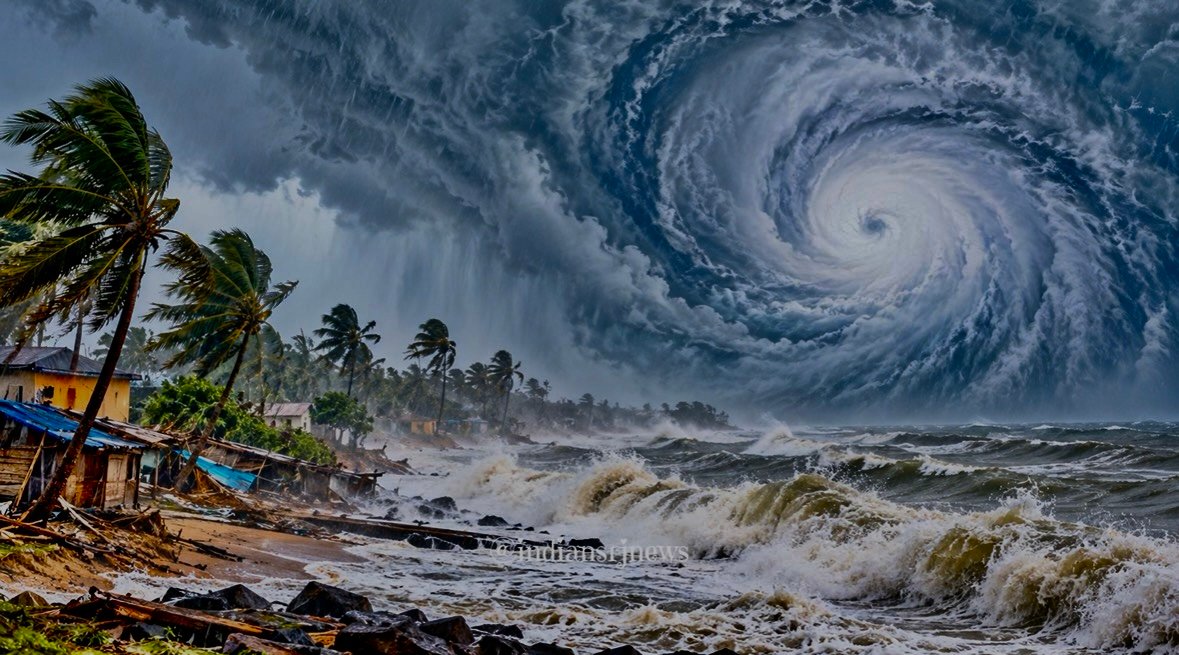
Why Are Cyclones Repeatedly Hitting India in 2026?
|
Getting your Trinity Audio player ready...
|
NEW DELHI: India’s eastern coastline has witnessed two powerful cyclones within a short period, raising fresh concerns about changing weather patterns over the Bay of Bengal. Cyclone Arnab struck the Andhra Pradesh coast on October 28, followed by Cyclone Murasu, which crossed the southern Andhra Pradesh coast on November 3. The back-to-back storms have raised an important question: Is India experiencing more cyclones than usual? Is the Indian Ocean becoming warmer? And could climate change be influencing the intensity and behaviour of these storms? Scientists point towards a combination of ocean warming, atmospheric moisture, wind patterns, seasonal changes, and large-scale climate phenomena such as El Niño and La Niña. However, the distinction between cyclone frequency and cyclone intensity is essential to understanding the situation.
How Many Cyclones Have Formed in India in 2026?
As of November 3, 2026, two named cyclonic storms have been reported in the North Indian Ocean’s 2026 season, both affecting India’s eastern coastline.
1. Cyclone Arnab
Cyclone Arnab developed over the Bay of Bengal in late October and made landfall along the Andhra Pradesh and Yanam coast on October 28, 2026.
It intensified into a Very Severe Cyclonic Storm, with maximum sustained winds of approximately 125–135 kmph and gusts reaching 150 kmph during landfall.
2. Cyclone Murasu
Within a few days of Arnab, another powerful system developed over the Bay of Bengal and was named Cyclone Murasu.
According to the India Meteorological Department (IMD), Murasu crossed the southern Andhra Pradesh coast between Nellore and Narsapur, close to Ongole, between 3:30 a.m. and 5:30 a.m. on November 3.
During landfall, it recorded sustained wind speeds of 100–110 kmph, with gusts reaching 120 kmph.
An important clarification: These are the two named cyclonic storms identified in the available 2026 season reports as of November 3. Depressions, deep depressions, and low-pressure systems are different categories and should not automatically be counted as named cyclones.
Why Does India Experience More Cyclones During October and November?
The North Indian Ocean generally experiences two major cyclone seasons.
- Pre-monsoon season: April to June.
- Post-monsoon season: October to December.
The post-monsoon period is particularly active over the Bay of Bengal.
After the withdrawal of the southwest monsoon, atmospheric conditions begin changing. Warm ocean water, moisture availability and favourable wind conditions can create an environment suitable for cyclone formation.
A 2026 study published in Scientific Reports analysed 41 years of data from 1982 to 2022. It found that approximately 64.6% of Bay of Bengal cyclones occurred during the post-monsoon season.
Therefore, the occurrence of two cyclones in late October and early November is consistent with India’s established seasonal cyclone pattern, even though their close timing is significant.
Five Major Scientific Factors Behind Cyclone Formation
1. Rising Sea Surface Temperature
Warm ocean water is the primary energy source for tropical cyclones.
When sea surface temperatures reach approximately 26.5°C or higher, and sufficient heat is available below the surface, conditions can become favourable for tropical cyclone development.
The Bay of Bengal provides favourable conditions because of its warm waters and high atmospheric moisture.
Scientific research indicates that the Bay of Bengal’s sea surface temperature has increased by approximately 0.5–0.6°C over the past four decades.
However, warmer water alone cannot create a cyclone. Atmospheric circulation, moisture, and wind conditions must also be favourable.
2. Climate Change and Global Warming
Global warming is increasing the amount of heat stored in the world’s oceans.
Warmer oceans can increase evaporation and provide more moisture to the atmosphere. When water vapour condenses inside a developing cyclone, latent heat is released, helping sustain the storm.
Research supported by India’s Department of Science and Technology has identified warmer sea surface temperatures, higher mid-level atmospheric humidity and weaker vertical wind shear as important factors associated with increasing cyclone intensity in the North Indian Ocean.
This does not necessarily mean that the total number of cyclones will increase every year. Climate change can influence storm intensity, rainfall, rapid intensification,n and potential damage differently from overall cyclone frequency.
3. El Niño and La Niña
El Niño and La Niña are major climate patterns in the Pacific Ocean that influence weather conditions across the world, including the Indian Ocean.
During El Niño, warmer-than-normal water develops in the central and eastern equatorial Pacific. This changes atmospheric circulation and can influence cyclone-forming conditions over the Bay of Bengal.
Several studies have found that El Niño conditions are generally associated with fewer tropical cyclones over the Bay of Bengal, while La Niña conditions can favour increased cyclone activity under certain atmospheric conditions.
An important development in 2026 is the strengthening El Niño.
According to NOAA’s October 8, 2026, ENSO report, El Niño was strengthening, with a strong-to-very-strong event considered likely through January–March 2027.
Interestingly, the current year has witnessed two powerful cyclones despite the climate pattern generally associated with reduced cyclone activity over the Bay of Bengal.
This demonstrates that El Niño does not completely prevent cyclone formation. Local ocean temperatures, atmospheric moisture, re and wind conditions can still create favourable conditions for powerful storms.
4. Ocean Heat Content
Sea surface temperature is not the only factor that matters. Scientists also study how much heat is stored beneath the ocean’s surface.
This is known as Ocean Heat Content (OHC).
When warm water extends deeper into the ocean, a cyclone can continue receiving energy even when its strong winds mix the upper layers of seawater.
This can help a storm maintain its strength or intensify further.
A 2026 study published in Scientific Reports examined the relationship between upper-ocean heat, atmospheric conditions, and cyclone intensification over the Bay of Bengal.
The research highlights the importance of subsurface ocean conditions in understanding cyclone behaviour.
5. Vertical Wind Shear
Vertical Wind Shear is another major factor influencing cyclone development.
It refers to changes in wind speed or direction at different atmospheric heights.
Strong vertical wind shear can disrupt the organised structure of a cyclone and prevent it from strengthening.
On the other hand, weak vertical wind shear allows the storm to maintain its structure and develop more efficiently.
This explains why not every low-pressure system over a warm ocean develops into a powerful cyclone.
What Does Scientific Research Say About Increasing Cyclone Activity?
Research does not provide a simple answer that India is experiencing an uninterrupted increase in the number of cyclones.
A study published in Scientific Reports on May 12, 2026, examined cyclone activity over the Bay of Bengal using 1982–2022 data.
Its findings highlighted important changes in ocean-atmosphere conditions, cyclone movement,t and intensification patterns during recent decades.
The study also found that approximately 75% of North Indian Ocean tropical cyclones originate over the Bay of Bengal.
Another analysis published by the Indian Institute of Remote Sensing (IIRS) in July 2026 examined 30 years of cyclone activity from 1996 to 2025.
According to the analysis:
- The North Indian Ocean experiences approximately four tropical cyclones annually on average.
- Eight cyclones were recorded in 2019.
- Seven cyclones were recorded in 2018.
- The Bay of Bengal contributes more cyclones than the Arabian Sea.
- Overall cyclone frequency has remained broadly stable, with a relatively small positive long-term tendency in the analysed dataset.
These findings suggest that year-to-year cyclone activity can vary considerably. The occurrence of two powerful storms within a few days does not, by itself, establish a long-term increase in cyclone frequency.
Could India Face Greater Cyclone Risks in the Coming Years?
The bigger concern for scientists is not simply the number of storms but their intensity, speed of strengthening, rainfall potential and impact on coastal communities.
The eastern coastline, particularly Andhra Pradesh, Odisha, West Bengal and Tamil Nadu, remains exposed to cyclones originating over the Bay of Bengal.
Rising sea levels can also increase the risks associated with storm surges and coastal flooding.
In addition, heavy rainfall associated with cyclones can affect inland regions, including parts of Telangana, Chhattisgarh, Bihar and eastern Uttar Pradesh, depending on the storm’s track and remaining moisture.
However, the actual impact on any particular region depends on the cyclone’s direction, intensity, speed and weakening pattern.
Conclusion
The consecutive arrival of Cyclone Arnab and Cyclone Murasu along the Andhra Pradesh coastline has once again highlighted the importance of understanding cyclone activity over the Bay of Bengal.
Scientific evidence suggests that warmer oceans, increased ocean heat content, atmospheric moisture, vertical wind shear, and global climate patterns all influence cyclone formation and intensity.
Although there is no conclusive evidence that the total number of cyclones is continuously increasing every year, changes in cyclone intensity and behaviour deserve serious attention.
As climate change continues to influence ocean and atmospheric conditions, stronger forecasting systems, early-warning mechanisms and coastal disaster preparedness will become increasingly important for India.
The key question is no longer just how many cyclones form, but how powerful they become and how effectively India can prepare for their impact.