India’s First Bullet Train Project Achieves Major Milestone
|
Getting your Trinity Audio player ready...
|
New Delhi/Ahmedabad: India moves closer to high-speed rail operations
India’s ambitious first bullet train project has achieved a significant technical milestone, bringing the country closer to introducing high-speed passenger rail services.
The overhead electrical system on the approximately 50-kilometre Surat–Bilimora section of the Mumbai–Ahmedabad High-Speed Rail Corridor was successfully energised on November 20, 2026.
The National High Speed Rail Corporation Limited (NHSRCL), responsible for implementing the project, confirmed the development. The Ministry of Railways subsequently shared the announcement on November 21.
The achievement represents an important step towards the testing phase of India’s first high-speed railway corridor.
However, energising the overhead electrical system does not mean that passenger services have started. Several technical tests, safety assessments and regulatory procedures remain necessary before commercial operations can begin.
1. What happened on the Surat–Bilimora section?
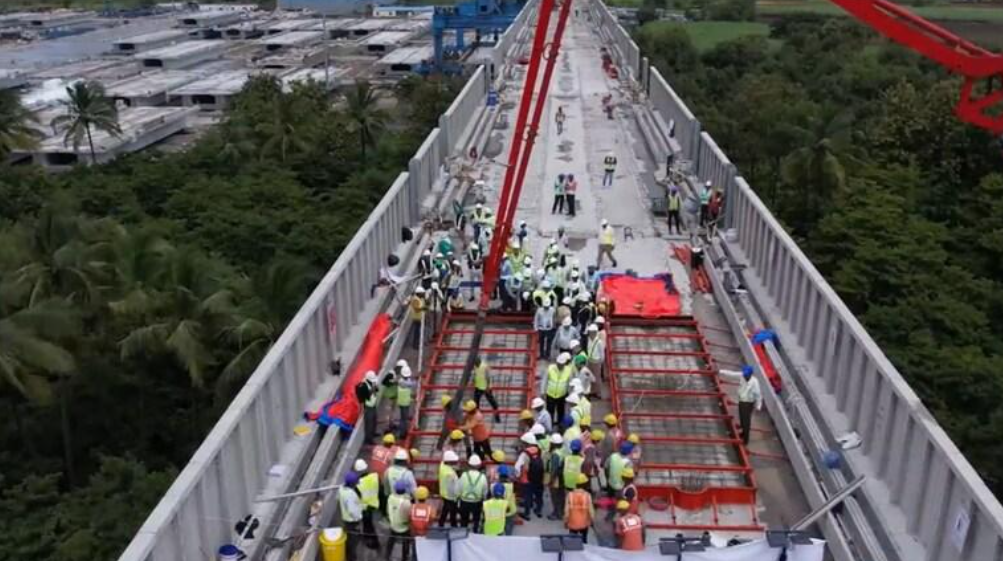
The latest milestone involves the successful energisation of the Overhead Equipment system on the elevated railway alignment between Surat and Bilimora in Gujarat.
The approximately 50-kilometre stretch includes both the Up and Down railway lines.
The Overhead Equipment system consists of electrical wires, supporting structures, masts and associated installations that supply electricity to electric trains.
For a high-speed railway network, the electrical infrastructure must provide a stable and reliable power supply even when trains operate at very high speeds.
The energisation process was completed on November 20 under technical supervision.
According to the railway authorities, the system will be energised progressively in smaller sections to ensure compliance with prescribed safety procedures.
This milestone will allow further technical and electrical testing activities to proceed.
It also demonstrates progress in the development of the corridor’s essential railway infrastructure
2. What is the Overhead Equipment system?
Overhead Equipment, commonly known as OHE, is one of the most important components of an electrified railway network.
It provides electricity to trains through overhead wires installed above railway tracks.
A device called a pantograph is mounted on the roof of an electric train. It maintains contact with the overhead electrical system and transfers electricity to the train’s electrical equipment.
In conventional railway operations, overhead electrification is already widely used.
However, high-speed rail requires more advanced engineering because trains operate at significantly higher speeds and require a reliable power supply.
The Mumbai–Ahmedabad project therefore uses a specialised high-speed traction system.
The electrical infrastructure must maintain suitable voltage, reliability and operational safety throughout the corridor.
3. Understanding the 2×25 kV traction technology
The Mumbai–Ahmedabad High-Speed Rail Corridor is equipped with an advanced 2×25 kV Overhead Traction System.
This technology is designed to meet the demanding electrical requirements of high-speed train operations.
Electricity will be received from the national power grid and distributed through dedicated substations before reaching the overhead traction network.
The system is designed to support stable electricity distribution along the 508-kilometre corridor.
The railway project includes 14 strategically located traction substations.
These facilities play an important role in ensuring that the train receives the required power throughout its journey.
The use of this technology is a major part of India’s introduction of high-speed railway electrification infrastructure. Press Information Bureau+1
The alignment passes through Maharashtra, Gujarat and the Union Territory of Dadra and Nagar Haveli.
A total of 12 stations are planned along the corridor:
| Station | State/Region |
|---|---|
| Mumbai | Maharashtra |
| Thane | Maharashtra |
| Virar | Maharashtra |
| Boisar | Maharashtra |
| Vapi | Gujarat |
| Bilimora | Gujarat |
| Surat | Gujarat |
| Bharuch | Gujarat |
| Vadodara | Gujarat |
| Anand/Nadiad | Gujarat |
| Ahmedabad | Gujarat |
| Sabarmati | Gujarat |
Approximately 352 kilometres of the corridor are located in Gujarat, while around 156 kilometres fall within Maharashtra.
The project is expected to improve connectivity between two major economic centres and introduce a new high-speed transport option for passengers.
It may also support economic activity around stations, industrial areas and commercial centres.
The main requirements include:
- High-speed railway tracks.
- Advanced overhead electrification.
- Modern signalling and train control.
- Specially designed bridges and tunnels.
- Advanced braking systems.
- Continuous monitoring and safety mechanisms.
The electrical infrastructure must be capable of supporting the train’s power requirements throughout the journey.
The 2×25 kV traction system is an essential part of this design.
8. How Gujarat could benefit from the bullet train project
Gujarat is one of India’s major industrial and commercial states.
Cities such as Surat, Vadodara, Bharuch and Ahmedabad play important roles in manufacturing, trade, services and economic activity.
The high-speed railway corridor is expected to create a new transport connection between these centres.
The potential benefits include improved business connectivity, increased tourism opportunities and development around railway stations.
The project may also create employment opportunities during construction and subsequent operations.
Technical maintenance, railway management, station services and supporting industries could generate additional economic activity.
However, the actual economic benefits will depend on passenger demand, ticket prices, station accessibility and the overall operation of the network.
9. How will travel between Mumbai and Ahmedabad change?
Mumbai and Ahmedabad are major economic centres with substantial passenger movement between them.
At present, travellers use flights, conventional trains and road transport to travel between the cities.
The introduction of high-speed rail will provide another option.
The project is designed to reduce journey times significantly compared with conventional rail services.
Business travellers, professionals and tourists may benefit from faster connectivity.
However, the actual journey experience will depend on station locations, service frequency, ticket prices and the time required to reach the stations.
The project could also encourage improved transport connectivity around the stations.
10. Major challenges before commercial operations
Despite the recent progress, several stages remain before the bullet train can begin commercial operations.
High-speed railway infrastructure requires extensive testing because trains operate at speeds significantly higher than conventional passenger services.
The authorities must assess track quality, overhead electrical equipment, signalling, communications, braking systems and emergency response arrangements.
The project also involves substantial civil engineering work, including bridges, tunnels, elevated structures and station construction.
Coordination between construction teams, electrical engineers, railway specialists and safety authorities will remain essential.
The completion of one electrified section is an important achievement, but it should not be confused with the completion of the entire corridor.
11. Public safety advisory after energisation
Following the energisation of the overhead electrical system, railway authorities issued a safety advisory.
The overhead wires on the specified section remain live after energisation.
Residents, construction workers, commuters and members of the public have been advised not to approach or touch electrical installations.
Unauthorised activities near the electrical infrastructure can result in serious accidents.
High-voltage electrical installations can be dangerous even without direct physical contact because electrical arcing may occur.
The public has therefore been advised to maintain a safe distance from the installations and follow all railway safety restrictions.
Conclusion
India’s first bullet train project has reached a significant milestone with the successful energisation of the overhead electrical system on the 50-kilometre Surat–Bilimora section on November 20, 2026.
The development brings the Mumbai–Ahmedabad High-Speed Rail Corridor closer to its next phase of technical testing.
With trials targeted for 2027 and initial passenger operations planned on the Surat–Vapi section, the project is gradually moving towards its operational stage.
Nevertheless, technical testing, safety approvals and remaining infrastructure work must be completed before passengers can board India’s first bullet train.
The successful energisation of the Surat–Bilimora section marks another important step in India’s journey towards high-speed rail transportation.