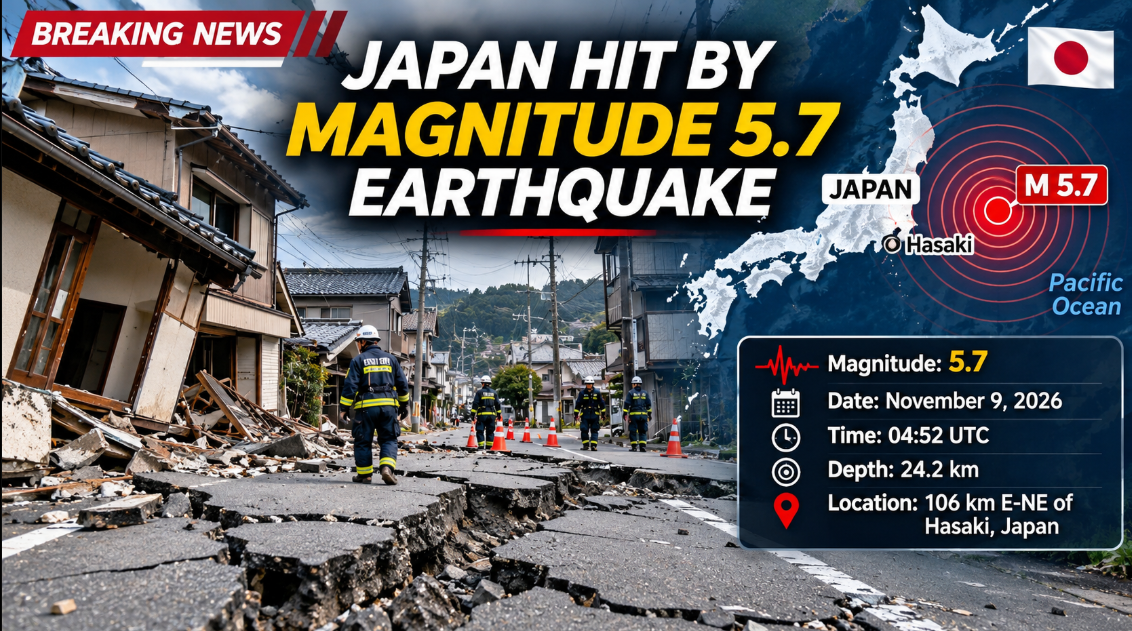
Japan Hit by Magnitude 5.7 Earthquake Tremors Off the Eastern Coast
|
Getting your Trinity Audio player ready...
|
Tokyo, November 9, 2026: An earthquake measuring magnitude 5.7 struck off the eastern coast of Japan on Monday, according to the United States Geological Survey (USGS).
The earthquake was recorded at 04:52 UTC on November 9, 2026, approximately 106 kilometres east-northeast of Hasaki, Japan. The earthquake occurred at a depth of approximately 24.2 kilometres.
The seismic event was recorded by the USGS National Earthquake Information Center and received a reviewed status in its earthquake monitoring system.
Japan is among the world’s most earthquake-prone countries because it is located in a region where several major tectonic plates interact.
Where Did the Earthquake Occur?
According to USGS data, the earthquake’s epicentre was located approximately 106 kilometres east-northeast of Hasaki, off Japan’s eastern coastline.
The recorded coordinates were approximately 36.247 degrees north latitude and 141.830 degrees east longitude.
The earthquake occurred at a depth of approximately 24.2 kilometres beneath the Earth’s surface.
The location places the event offshore, within a region where seismic activity is closely monitored by Japanese and international earthquake monitoring agencies.
What Was the Magnitude of the Earthquake?
The USGS recorded the earthquake at magnitude 5.7.
Earthquake magnitude measures the energy released at the source of an earthquake. A magnitude 5.7 event can produce noticeable shaking, depending on its depth, distance from populated areas and local ground conditions.
The actual effects on buildings and infrastructure depend on several factors, including construction standards and the distance between the epicentre and populated areas.
USGS also recorded a small number of public felt reports following the event.
Why Does Japan Experience Frequent Earthquakes?
Japan is situated along the Pacific Ring of Fire, one of the most seismically active regions in the world.
The country lies near the boundaries of several tectonic plates, including the Pacific, Philippine Sea, Eurasian and North American plates.
The movement and interaction of these plates create geological pressure that can be released through earthquakes.
As a result, Japan experiences frequent seismic activity and has developed extensive earthquake monitoring, early-warning and disaster-preparedness systems.
Japan’s Earthquake Preparedness System
Japan has invested heavily in earthquake preparedness following decades of experience with major seismic disasters.
The country operates advanced earthquake monitoring networks and public alert systems designed to provide warnings when significant shaking is expected.
Buildings in Japan are also subject to earthquake-resistant construction standards, although the level of protection varies depending on the age and type of structure.
Emergency drills, public education and disaster-response planning are important parts of Japan’s approach to earthquake risk management.
Are There Any Reports of Damage or Casualties?
The USGS earthquake record confirms the magnitude, location and depth of the November 9 earthquake.
However, the earthquake record alone does not establish whether there has been significant damage, injuries or casualties.
Verified information from Japanese emergency authorities would be needed before making claims about the impact of the earthquake.
The situation should therefore be monitored through official Japanese government and disaster-management updates.
Why Is This Earthquake Important?
Even moderate earthquakes receive close attention in Japan because of the country’s geological setting and population exposure.
An offshore earthquake can be felt across coastal areas depending on its magnitude, depth and distance from land.
The latest event highlights the importance of continuous earthquake monitoring and public preparedness in one of the world’s most seismically active countries.
Authorities and monitoring agencies will continue to assess seismic activity and provide updates if additional information becomes available.